

A new U.S. sanctions designation has confirmed Solmaz Bani’s place in Babak Zanjani’s corporate and cryptocurrency network—as both his partner and a behind-the-scenes operator.
On July 24, 2026, the U.S. Treasury Department’s Office of Foreign Assets Control imposed a new round of targeted sanctions intended to dismantle what it described as the shadow financial network of Iranian businessman Babak Zanjani.
The sanctions targeted Zanjani, four close associates—including Solmaz Bani, his sister Bahareh Morteza Zanjani, Zedpay chairperson Mehdi Rezazadeh, and Zedx manager Sukhrob Oimakhmadov—and the core of his business empire.
They also covered Dot One and its subsidiaries in rail, aviation, gold, barter, and travel, alongside overseas facilitators such as Zedpay in Turkey, Zedx DMCC in Dubai, and BZ Diamond FZCO.
The designations gave official weight to findings previously reported by OCCRP, Zamaneh, The Washington Post, and others, including allegations that Zanjani’s cryptocurrency network laundered money for the Islamic Revolutionary Guard Corps.
The Treasury’s sanctions announcement effectively confirmed many of the connections previously uncovered by reporters. It identified Solmaz Bani—also known as Niyoosha and Sara—as a Dutch national based in Dubai and described her as Zanjani’s “significant other.”
Who Is Solmaz Bani?
The story of Zanjani’s multibillion-dollar financial network cannot be fully understood without examining the woman whose name appeared behind several of its companies.
Solmaz Bani is a Dutch citizen who lived in Dubai for at least part of this period. Archival photographs indicate that she formerly worked as a model and was then known as Niyoosha Bani.
Corporate records connected to Zanjani also identify her as Sara Bani and Solmaz Bani. Before deleting her social-media accounts, she used the online alias “Niu Niu.” Facebook and Instagram posts documented what Bani publicly presented as a romantic relationship with Zanjani.
She left numerous traces of the relationship across her social-media accounts. Between January 2020 and March 2025, her Facebook feed became an elaborate public celebration of their life together. She posted photographs of flowers and gifts that Zanjani had sent her, celebrated his birthday in March, and called him “Booboo” and, on other occasions, “a great businessman with a heart of gold.”
In a 2022 Facebook post, she wrote:
“The best feeling is being loved back by the person you love. Happy to love and be loved by you. My B.Z.”
Her Instagram biography described her as the “Happy Happy Heart of BZ,” initials that appeared to refer to Babak Zanjani.
Zanjani’s own account liked several of Niyoosha’s posts and occasionally left comments. Comments from her could likewise be found beneath photographs posted on his Instagram account.
Bani also travelled to Iran during their relationship.
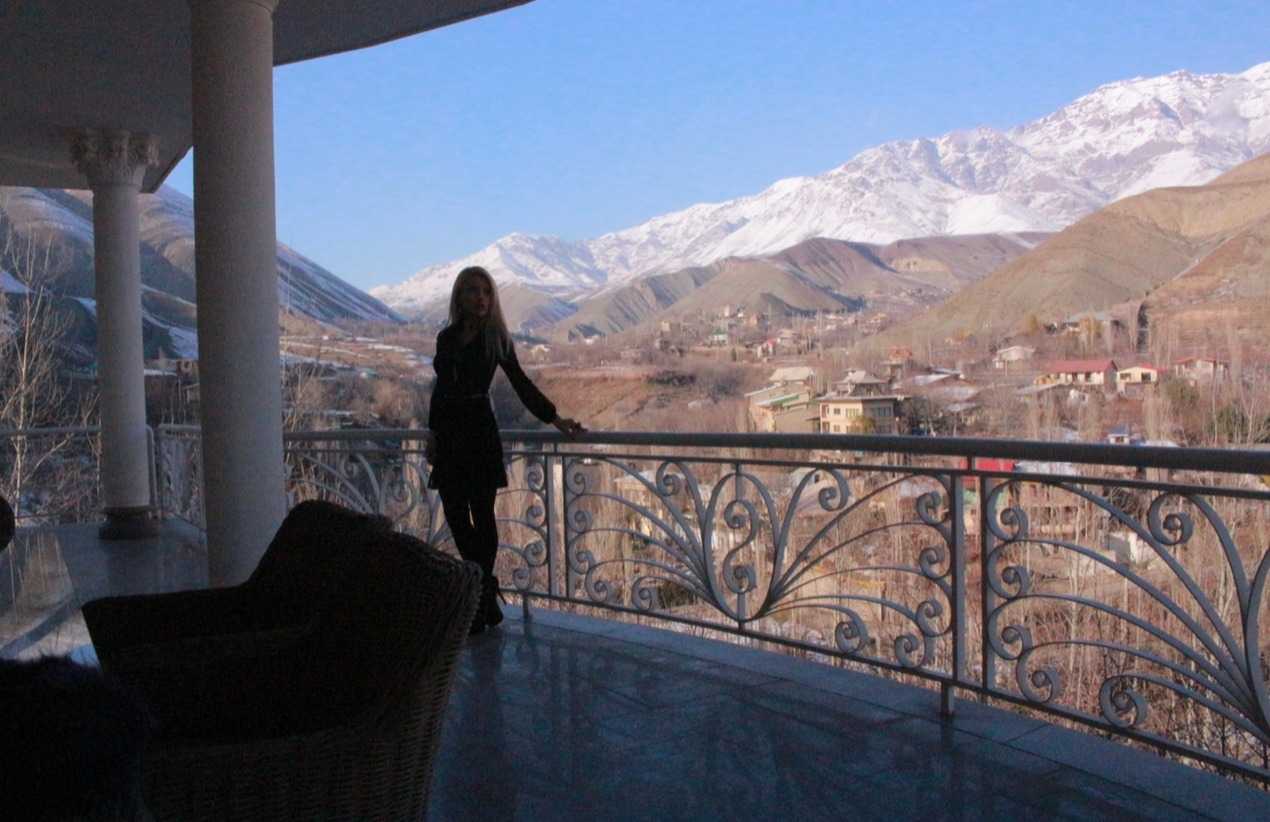
On social media, she posted photographs of herself on the terrace of a luxurious villa. The foothills of the Alborz Mountains were visible behind her, along with the terrace’s distinctive railings.
Journalists compared the skyline, mountain range, and railings in her photographs with images of Zanjani at a villa. They concluded that both sets of photographs had been taken at the same property in the foothills of northern Tehran.
A Behind-the-Scenes Corporate Role
Bani’s involvement was not limited to her relationship with Zanjani. Variations of her name were used to register companies connected to his business network. Her social-media posts presented the relationship as intimate and long-term, while her corporate positions tied her increasingly closely to Zanjani’s business empire.
Zanjani appointed her president of BZ Group, his Dubai-based corporate network. She was also listed as the contact person for the BZ Group website in the United Arab Emirates and as the controlling owner of a now-dissolved British company with the same name.
In August 2020, Bani registered a British company called Iban 2 Iban. She also held a stake in a Dubai motorcycle business called BZ Motorcycles. Telephone numbers associated with these businesses were registered under both Niyoosha Bani and Solmaz Bani.
Meanwhile, Zanjani’s British cryptocurrency exchanges, Zedcex and Zedxion, presented a purported executive named Elizabeth Newman as their chief executive.
The woman depicted as Newman in promotional materials was in fact a model whose image had been taken from stock footage. Behind this fabricated corporate persona, the available evidence suggested that Bani was playing a genuine operational role.
A client testimonial for BZ Broker, published on the website of a blockchain-development company, was signed in Bani’s name. Her digital footprint could be found throughout the network.
Internet-registration records showed that Bani had registered domains used to distribute Zedxion’s online newsletters and to send account-registration emails and password reminders for Zedcex.
In a tutorial uploaded to Zedxion’s official YouTube channel, the browser briefly displayed its autofill information. The names “Solmaz” and “Babak” appeared together on the screen.
A Pet, a Photograph, and a Digital Trail
Even the couple’s pet cat became part of the digital trail connecting their private lives to the cryptocurrency companies.
In May 2024, Zedxion’s official Telegram channel—one of the exchange’s formal communications platforms—posted a photograph of a predominantly white cat with grey and brown markings and a bright purple bell attached to its collar.
In February 2025, what appeared to be the same cat, wearing the same purple bell, appeared in the cover photograph of Niu Niu’s Facebook account.
In Bani’s photograph, the cat was sitting beneath a table and chairs with highly distinctive legs.
A photograph circulating on a Babak Zanjani fan page showed Zanjani playing with a dog beside what appeared to be the same table and chairs.
Babak Zanjani’s Return
In late June 2025, during the twelve-day war between Iran and Israel, a curious story was lost amid the flood of war news.
In several posts on X, Zanjani claimed that Israel had targeted his office on the upper floors of a tower at Tehran’s Jahan Koodak junction. He later published photographs showing broken glass inside the office.
Zanjani himself was the only source for the claim. Neither Iranian nor Israeli authorities confirmed that his office had been targeted.
Unsubstantiated rumours nevertheless circulated that Revolutionary Guard intelligence officials had used the office to supervise Zanjani’s renewed business activities following his formal release from prison around a year earlier.
None of these claims was supported by an identifiable source, and they remained rumours. But the episode raised a larger question: why would Babak Zanjani have been important enough for Israel to target?
A decade earlier, Zanjani had been Iran’s most notorious sanctions-busting financier. He moved money through an intricate network of shell companies and fictitious banks.
His empire collapsed in 2013. The United States sanctioned him, and an Iranian court subsequently accused him of stealing billions of dollars belonging to the Oil Ministry. He was eventually sentenced to death. Yet the man who was supposedly awaiting execution managed to reinvent himself.
Around a decade later, Zanjani returned to the worlds of sanctions evasion and money laundering. This time, instead of selling oil through an old-fashioned network of banks, paperwork, and shell companies, he had turned to blockchain technology.
He built a multibillion-dollar cryptocurrency empire for the same political system that had sentenced him to death.
The story of this empire—directed by Zanjani from behind the scenes and later accused by the United States of laundering money for the Revolutionary Guard—had already been reported extensively by OCCRP and Zamaneh.
But one obvious question remained unanswered: how had any of this been possible?
Out of Prison Before His Official Release
By March 2016, Iran’s Supreme Court had upheld Zanjani’s death sentence. Officially, he was supposed to remain in Evin Prison. Yet rumours and scattered reports suggested that he was already outside prison.
In a September 2025 interview, Tehran-based journalist Yashar Soltani said:
“Babak has been out for years, and he has been working.”
A document later obtained by investigative journalists showed that Zanjani had quietly been allowed to leave Evin years earlier. According to the document, he left the prison under supervision on June 19, 2019. The date corresponded with rumours and reports claiming that he had been moved to a luxurious villa in the Alborz Mountains.
The billions of dollars that Zanjani had hidden gave him leverage. He also possessed knowledge of sanctions-evasion methods—or, at the very least, had persuaded elements within the political system that he did. For reasons that remain unclear, a faction inside the establishment appears to have trusted him.
But Zanjani’s debt of approximately €2 billion to Iran’s Oil Ministry—the very debt for which he had been sentenced to death—had never disappeared from public memory. The judiciary therefore faced a public-relations problem. A man whom its own judges had convicted of stealing billions of dollars in public oil revenue could not simply be released without explanation.
Zanjani’s return unfolded gradually: a documented departure from Evin under supervision in June 2019, public hints of possible leniency in 2021, official claims that his foreign assets had been recovered in 2023, and the formal announcement of his release in May 2024.
In June 2021, the head of the Supreme Court suggested that Zanjani might receive a reduced sentence if he “cooperated.” It later became clear, however, that Zanjani had already been allowed out of prison.
In early 2023, the judiciary began what appeared to be an effort to prepare public opinion for his formal release.
Officials first announced that Zanjani’s foreign assets had been “identified.” They then claimed that his debts to the state had been paid in full. His official release was announced in May 2024. But rather than ending the controversy over Zanjani’s debts, the announcement marked the beginning of a new phase.
The Debt That Never Disappeared
In late August 2025, Iran’s Central Bank publicly broke with the judiciary’s account. The bank said that Zanjani still owed approximately €1.8 billion. Of an original debt approaching €2 billion, it said, he had repaid only €15 million.
The Central Bank also stated that the cryptocurrency assets Zanjani claimed to possess—the same assets the judiciary had cited to justify his release—had been determined to be worthless. At the time, the story appeared confusing, contradictory, and difficult to follow.
In retrospect, however, the Central Bank’s announcement came at roughly the same time that Israel’s Ministry of Defence had frozen cryptocurrency assets connected to Zedxion and Zedcex. The controversy over Zanjani’s unpaid debts caused an uproar in Parliament.
By November 2025, members of Parliament were openly criticising the circumstances of his release and questioning how his debt had supposedly been repaid. Member of Parliament Meysam Zohourian wrote on X that Zanjani had repaid less than one per cent of what he owed.
Another parliamentarian, Amirhossein Sabeti, entered into a public dispute with Zanjani. “If justice had been properly carried out,” Sabeti said, “Zanjani would have been executed by now—not reintroduced as an ‘economic saviour.’”
Sabeti gave Zanjani a two-month ultimatum to return the missing funds. Zanjani’s response was extraordinary.
“Listen, you child of an MP,” he wrote on X. “If you cannot prove who the thief is, I will turn you inside out and make you a lesson for every infiltrator in this country.”
But what lay behind the dispute? Zanjani was reportedly supposed to transfer cryptocurrency assets to the state treasury and the Central Bank as repayment of his debt. Those assets had been blocked under sanctions.
Zanjani, who had long presented himself as a soldier on Iran’s “economic front,” appeared confident that he could not be blamed if the United States or Israel froze the cryptocurrency. Yet earlier investigations had already shown that he had left such an extensive digital trail that denying his relationship to the assets would have been extremely difficult.
It was also possible that his limited familiarity with the new financial technology had itself helped investigators identify and trace the funds. During the dispute between Zanjani, the Central Bank, and members of Parliament, Hamzeh Safavi—the son of Rahim Safavi, an adviser to Iran’s former supreme leader—made a revealing statement in a video interview:
“Since September 15, a new development has occurred in the history of sanctions. A very large sum—$1.8 billion in cryptocurrency belonging to Iran, which was believed to be immune to sanctions—has been blocked.”
The Central Bank’s figure of approximately €1.8 billion referred to Zanjani’s outstanding debt. Safavi’s separate figure of $1.8 billion referred to Iranian cryptocurrency assets that had reportedly been blocked. The similarity in the amounts and timing strengthened suspicions that the frozen cryptocurrency was connected to Zanjani’s attempted repayment. The available evidence, however, does not by itself conclusively establish that the figures referred to precisely the same pool of assets.
Safavi’s remarks nevertheless appeared to support the broader conclusion that the cryptocurrency intended as repayment represented Iranian oil revenue and that, once the assets were frozen, Zanjani’s debt remained unpaid.
From Cryptocurrency to the Dot One Empire
Zanjani’s return was not limited to cryptocurrency. Iranian media reported that after his official release, he had returned to conventional and ostensibly legitimate business.
He launched a large new portfolio under the name Dot One Group, an umbrella conglomerate spanning railways, aviation, gold, diamonds, media, and other sectors. The composition of Dot One’s board was noteworthy. According to Iranian media reports, it included a former Revolutionary Guard officer, a former member of Parliament, and a former lawyer for Mahmoud Ahmadinejad.
Not long after Zanjani’s formal return, one of Dot One’s subsidiaries signed a memorandum of understanding with the Islamic Republic of Iran Railways in the presence of the minister of roads and urban development.
Iranian reports valued the agreement at 610 trillion tomans—approximately $10 billion.
In late July 2026, the U.S. Treasury sanctioned not only Zanjani, his partner, and other people associated with him, but also the Dot One conglomerate that he had been heavily promoting on social media. The night after the sanctions were announced, a U.S. State Department spokesperson referred to Zanjani in a post about the new measures.
A year earlier, Zanjani had threatened to “turn an Iranian parliamentarian inside out” during their dispute over his unpaid debt.
His response to the U.S. government was considerably more restrained.
Quoting the State Department post, he wrote in English:
“The companies and individuals sanctioned by the United States outside Iran have no commercial relationship with me, nor have they ever had one. I am an Iranian businessman and have always operated in the interests of my company and my country.
Regional security and economic stability, however, are shared interests among all countries. If Iranian businesses and entrepreneurs are prevented from conducting legitimate trade throughout the region, the commercial interests and activities of American companies will inevitably face serious challenges as well.
Lasting security, stability, and economic prosperity can be achieved only when lawful and fair trade is available to everyone. Developments in the coming days will demonstrate that the region’s economic security is a shared responsibility and cannot be guaranteed unilaterally.”
The Treasury said that by sanctioning these individuals and entities, OFAC had blocked any property and financial interests they held in the United States or under the control of U.S. persons. The measures also prohibit U.S. institutions and individuals from facilitating transactions involving those designated and expose non-U.S. companies to sanctions risks if they assist the network.
The stated purpose is to close some of the principal channels through which Zanjani’s companies allegedly circumvented international sanctions.