

Across four days in Tehran, Ghazal records war, censorship, class unease, loneliness, and a stubborn hope that survives repression.
What follows is Ghazal’s account of four days in Tehran, written two days before Nowruz and two days after it. Because of the internet blackout, these texts reached Radio Zamaneh later.
Thursday, 28 Esfand 1404 (March 19, 2026) / Tehran / Ghazal
Today, after about twenty days, I left my area for the first time. I felt fear and excitement at once. Tehran was crowded, though not with the usual rush of the days before the New Year. As I drove, I kept telling myself: Ghazal, be careful, go slowly. If you get into an accident, no police will come and you’ll be stranded in the street. Lock the door. If someone tries to mug you again like last time, there will be no one to turn to. The GPS apps were not working, and as someone from a generation that has spent most of its life getting around with Waze, I kept circling around until, by relying on a thousand landmarks and asking directions, I finally reached my destination on the other side of Tehran. Across the city, giant ideological billboards had been put up, and the neighborhood walls were covered with graffiti saying Death to America and Israel. Going from one end of Tehran to the other and back, even without traffic, completely drained me.
When I returned to my own familiar, beloved neighborhood, I saw the stalls for New Year goods spread out. In front of the flower shops there were Sabzeh and all kinds of Haft-Seen items. Outside the protein shops they had lined up fresh fish. The pastry shops and fruit sellers were busy. And when I say busy, I mean in relation to wartime conditions. Compared to the days before the New Year in past years, I should say the place was utterly deserted.
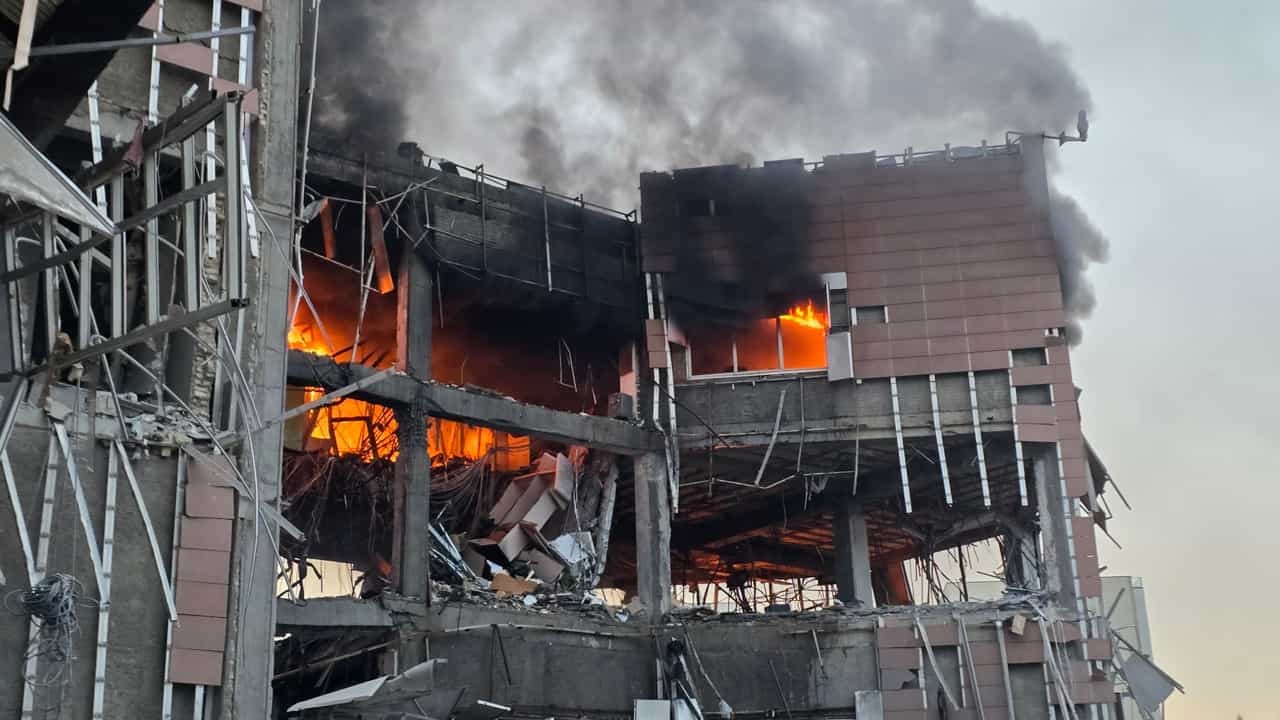
I wanted garlic and sabzeh for my Haft-Seen table. But when I reached the shops and the street vendors, my eyes suddenly filled with tears. I thought of the explosion a few days earlier in Zarafshan, Tehran, and that commercial building that had been leveled to the ground. There too, just like where I was standing now, there had been a dry cleaner’s, a bank, a flower shop, a bakery, a real estate office, a supermarket, and so on. And just like today, just like this very moment, people had been shopping there — and a moment later, right before the New Year, they were dead. That pointless, that absurd, that senseless.
I bought what I needed and stood there for a while watching people. It was as if everyone just wanted to get their shopping done and take refuge at home as quickly as possible. Then suddenly the air defenses were activated, and the panic turned into something tinged with anger and rage. A mother shouted at her daughter: “Didn’t I tell you to hurry up? What’s the difference between this sabzeh and that one? They’re striking. It’s dangerous!” Another passerby, frustrated and desperate, asked me: “What is that sound right now? Are we firing, or are they?” Someone else was telling his friend: “Don’t go that way. There’s a checkpoint. It’s dangerous.” For several minutes I leaned against a wall, staring at the people, their words, and the firing and explosions of the air defenses.
A few years ago I was watching a film set in Syria during the war. In one scene, some young people are having a party in a house, and two of them go out onto the balcony to smoke. They are talking about the war, and in the view beyond the balcony you can see the firing and explosions of the air defenses. At the time I did not know what air defense was, and I thought those were enemy missiles bombing the city. I was agitated and could not understand why, in that situation, they were throwing a party and smoking so calmly and looking out at the explosions. Something in my head was shouting: Run, girls! This is no time for getting drunk and smoking and dancing.
And now here I am, staring at explosions, holding garlic and sabzeh for the Haft-Seen in one hand, fiddling with a VPN in the other — one that has not stayed connected for even two minutes all day — and thinking that I should go home, arrange my Haft-Seen for tomorrow, then walk to my friend’s house so we can talk for a while and drink wine with the sound of explosions in the background. I will tell her about my frustration and helplessness in the face of the triangle of madness — the Islamic Republic, America, and Israel — and complain that we are powerless against these lunatics. I will tell her that, in a completely masochistic way, I am reading Kapuściński’s Another Day of Life, and that I am terrified, like a dog, that the war might spread or turn into civil war, that my stomach is in knots, and then I will read her the book’s preface, where it says:
Lord, despite all our many prayers to You, we keep losing our wars. Tomorrow another battle awaits us, one that truly matters. With all the strength we have, we still need Your help. So I want to ask something of You: tomorrow’s battle is different from the others. It is no place for children. So I must beg You not to send Your son to help us, but to come Yourself.
Friday, 29 Esfand 1404 (March 20, 2026) / Ghazal / Tehran
Today I was caught up in the rush of the New Year. At moments I forgot that we were in the middle of a war. But when I was paying for fish and greens and things like that and saw the astronomical prices, or when I was walking in the street and suddenly the air defenses were activated and I heard explosions in the distance, I was thrown right back into the filthy reality of these days.
I am a lucky person. The very fact that my family and social background still have enough means that, in the middle of a war, I have not yet become homeless, that I can still make stuffed fish, that I can still set a Haft-Seen table, take a Hafez omen, and drink wine — that, to me, is luck. Even though economic pressure has gradually grown heavier on us too over the past years, and much of the comfort, leisure, travel, and ease with which we once lived has become severely limited in recent years, still, it can be said that our situation is not the worst. A large part of the people of Iran are now truly facing crises of food and shelter, and that is a catastrophe. For now, it seems the situation is getting worse every day.
And yet I feel a strange, unfamiliar hope inside me. A feeling as though I want to believe that maybe this year, however difficult it may be, perhaps this time our hen too will finally lay a golden egg. I do not know how or when this optimism took root in me, especially in the middle of a war, amid this barrage of terrifying, incoherent media noise and all the chest-thumping by the different sides in this war, against one another and against us.
Us, the people? Which people? What right do I — lying beside my cat on my bed, writing these memories on my laptop after a full New Year’s dinner and plenty of wine — have to speak for someone who, even now, on this very holiday, is running through the streets in search of a morsel of bread? As a nonreligious person, what right do I have to speak on behalf of Muslims or Christians and pronounce what “we” want or do not want? Every time, whether intentionally or not, that I say “we the people,” I should ask myself who exactly I am talking about.
How often that phrase is repeated these days. It is like a contagious virus. Everyone allows themselves to stand in the position of spokesperson and address everyone under a single flag: “we, the people of Iran / Islam,” “we, the brave nation / the martyr-producing nation / the loyalist nation,” as though anyone unlike them is not really people at all, and as though something called the self, or individuality, should not exist, and as though phrases like “peoples,” “different groups of people,” and every form of discourse that does not place everyone under a single flag have become taboo.
I did not think I had caught this virus too. But even when I reread my notes from the previous days, I realized that I had used this word many times. How difficult it is to reject despotism and single-voiced thinking, to respect and recognize the plurality of individuals and ideas. I once heard someone say: “To be committed to freedom means that I want freedom even for my ideological enemy, and I am willing to struggle for that person’s freedom too.” What a heavy responsibility it is to love freedom. Especially when even recognizing the existence of the other in our discourse and spoken language is so difficult, as though the other should not exist at all.
These days, morning and night, the Islamic ideological government keeps sending messages to what it calls “we the people.” Sometimes I feel as though a deranged stalker is harassing me. At seven in the morning, at eleven at night, at one after midnight, message after message arrives — messages I have no desire to receive and yet cannot stop: all public transportation services are now free… collective prayer of the people of Iran and recitation of the prayer of… supplication and invocation for the victory of the fighters of Islam today at… America has said our gatherings are artificial intelligence… the starting time of the rally in support of the fighters… dear compatriot, in order to preserve sacred unity and patriotic defense… dear compatriot, in order to confront the American-Zionist enemy… Enough! Enough! Enough!
To escape these endless, exhausting assaults, I struggle like hell to connect to the VPN. And instead of reading the news — news now filled with phrases like “according to unconfirmed reports, informed sources say that perhaps…” and suffocating with uncertainty and ambiguity — I open Duolingo, supposedly to distract myself for a while. I complete one lesson, and instead of the usual ads I am confronted with a new one: Conscripts, the regime is collapsing. Go home to your families and do not put your lives at risk. Then another appears: People of Iran, victory is near. Stay united. I take a deep breath to let out some of my anger, but it turns into laughter. Only someone as mad as me, in the middle of a war, in a country without internet, after finally managing to connect for ten miserable minutes, would open Duolingo — and even there still be forced to look at these declarations and calls to action. What conscript is using Duolingo in the middle of a war, for God’s sake? This flood of unwanted messages from both sides feels to me like a kind of assault on the mind. Enough! Enough! Enough!
From this battlefield that bombards not only the country and the home but even our minds, I take refuge in Hafez. I tell him about the all-encompassing madness of these days, about the huge weight of uncertainty, exhaustion, and devastation, about my strange hopefulness and optimism, my frightened heart and furious mind, and he replies:
Hafez, be patient, for on the path of love,
whoever did not give their life did not reach the beloved.
Saturday, 1 Farvardin 1405 (March 21, 2026) / Tehran / Ghazal
I feel both love and hatred at once toward crowded, noisy Tehran. Today, when I saw how empty and deserted my Tehran was, rage and grief twisted through me and crushed me inward. My tears flowed silently. I do not like these vague, war-stricken days. A deep loneliness has wounded my soul. In the Gospel of Matthew it is written: “Do not fear those who kill the body but cannot kill the soul.” And I feel that living under despotism does not kill only the body. Living under despotism has brought us blood, forced silence at gunpoint, and death — and now all of that has surged back in the form of war, more savage than ever.
I have always loved writing, and I have always written. But where I am, my words are a crime, simply because I write whatever I think without regard for expediency, religion, or any particular ideology, and I cannot publish my words freely, openly, under my own name, anywhere, without fear. And that is not the whole story. I do not even have the desire to read my writing to those closest to me. Something grips my throat and will not let the words come out easily.
Years ago, when my rebelliousness and excitement were at their height, and when I had not yet come face to face with the repressive apparatus, I wrote and said everything everywhere and read it aloud to everyone. Now I think of the barrage I experienced from my dearest ones — sometimes out of fear, sometimes anger, sometimes even love: “Don’t post these anywhere… you can’t just write down everything that comes into your head… I’m worried, take care of yourself… of all topics, why did you write about this?… don’t read this at your school…. don’t go read this at the university gathering…. you think too idealistically… is this really the time to be writing things like this?… didn’t they already shut down your blog? do you really need them to come arrest you?… you have no sense, you think you live in Switzerland…. three hours of interrogation wasn’t enough for you? do you have to get yourself killed?…” Little by little I wrote less, my voice grew quieter and quieter, I became more isolated, and I hid even those scattered writings from everyone.
These days I am also living through another form of loneliness and repression, one far more painful, sadder, and more exhausting than confronting the regime’s repressors or dealing with my loved ones’ anxieties. I remember a time when, at school, at university, and in the streets, we all stood together against reaction and despotism in whatever form they appeared. But these days even my friends, acquaintances, and those closest to me can no longer bear to listen or read. It makes no difference what political or ideological camp they belong to: either you say what they want to hear, or you fall silent, or you endure their verbal attacks, insults, and threats. Is this too part of the legacy of years spent breathing and living in the air of despotism and censorship?
So why am I still hopeful? Empty, silent Tehran crushed me inward and reminded me of the filthy, heavy loneliness I am carrying these days, and yet I do not know why I am still so hopeful about this country, these people, and the future. Perhaps it is true after all: “Do not fear those who kill the body but cannot kill the soul.” In this contradictory feeling of doubt and hope, my tears still flow silently, as though something in me is still alive, and resistance means life. So I write, even without a name. I write, even if no one reads. I write so that perhaps, in the midst of war, despotism, and repression, with the help of words, Woman, Life, Freedom may remain alive.
Monday, 3 Farvardin 1405 (March 23, 2026) / Tehran / Ghazal
Yesterday I spent a long time away from home and from our neighborhood, and being that far away put me under such intense tension and psychological pressure that by the time I got back, with a pounding headache, stress, and palpitations, I took a sedative and went to sleep without even having the chance to write what had happened to me.
At the same time, through endless phone calls, effort, and follow-up, I am trying to get my hands on a Starlink device. But meanwhile I keep hearing reports of arrests and threats against people who have internet access these days, and of raids on the homes of people who have Starlink. The volume of stories, rumors, exaggerations piled upon exaggerations, and this deliberate production of fear and terror has become so great that distinguishing truth from lies is almost impossible.
One of my relatives told me that a few days ago an armed group of plainclothes agents stormed the home of one of their friends because they had learned the person was connected to the internet, and they confiscated all their phones and laptops. Or maybe they had Starlink and that was the reason. I do not know. But my body trembles. What if they storm my house too because of this half-functional internet connection I have? Everyone’s accounts are so fragmented and vague that you cannot say with certainty what exactly happened. One person says such-and-such place was blown up and leveled. Another says someone’s son was stopped at a checkpoint, and from fear and stress the young man had a heart attack and died. Someone else says intelligence agents called and threatened someone for saying certain things on the phone. Another person says someone took pictures of their bombed house, and agents attacked, detained them, and seized their phone. In one district where many buildings had been damaged, intelligence vehicles with plainclothes agents were reportedly stationed every few steps, arresting anyone who took photos or videos. Then everyone began analyzing what would happen if this place or that place were hit, if water, gas, and electricity were cut off, if there were no gasoline, no work, no money. In short: if we do not survive, then what?
I stayed silent. I watched the enormous stress that people were trying to vomit out through talking, narrating, and analyzing, just to feel a little lighter. And what stunned me most of all were their faces. As they were telling these stories, they did not outwardly seem angry, frightened, or even sad. What I saw from the outside was intense excitement, as though they were narrating a thrilling story. I feel that even emotional reactions have ceased to take their normal form and now erupt in strange and distorted ways.
The whole time, staring at faces and mouths, I kept thinking: how can they recount and analyze the catastrophe we are living through with such excitement and intensity? And over all of this there was the ceaseless, grating voice of domestic and foreign news media, as though they had won the lottery, speaking about Iran around the clock with such endless drama that it made me nauseous. Kapuściński’s words in Another Day of Life kept running through my head:
It is interesting to hear how the world debates, incites, seduces, threatens, postures, and lies. How everyone is right and no one wants to hear the voice of the other side… The world fixes its gaze on the grand spectacle of battle and death, a spectacle it ultimately cannot even imagine, because the image of war cannot be transmitted. Not by the pen, not by sound, not by image. War is reality, but only for those trapped inside its bloody, dreadful, filthy field. For everyone else, war is just pages in books.
I felt suffocated and intensely tense. My whole body was contracted, folded in on itself, and my heart was hurling itself madly against my chest. All of that intensified each time I reached a checkpoint. On the way I passed through three or four of them. They try to set themselves up under bridges or in heavily residential and commercial areas in order to reduce the risk of drone strikes. They almost always stop SUVs, pickup trucks, and trucks and search them thoroughly, and male passengers are still more suspect to them than female passengers, so men are stopped and searched more often.
Every time I reach a checkpoint, my breath catches. I feel like a fugitive criminal who might be caught at any moment. It is the feeling I have always had in encounters with the ideological forces of the IRGC and the Basij. However I look at it, from whatever angle, my very existence is illegitimate to this group, and my blood is licit to shed. Even to me it is strange how I am still living among them in my own way, how even when I pass through the midst of their armed forces I still do not wear hijab, and how, despite all this repression, I am still willing to take the risk of buying Starlink. Where does this strange force of resistance and struggle, this desire for freedom, come from? How is it that even under such conditions the black dog of depression has not taken hold of me?
Yesterday I heard so many tense accounts and endured so much tension in the city because of the heavily securitized atmosphere that I told myself I had better not go anywhere far from home or our neighborhood for a while. The news about Trump’s ultimatum and his threat to strike infrastructure has also weighed heavily on my mind, and I am deeply anxious. In the midst of all this, the government is once again sending us messages to the effect that if America hits our infrastructure, we will hit the infrastructure of the entire region. So what? What are we supposed to do with that? A bunch of madmen with your nonsense are destroying the whole world and killing thousands of ordinary, innocent people, and not one of you will climb down from your madness. Every day you bare your teeth at one another more wildly, more uncontrollably.
Last night, even with the sedative, I did not sleep peacefully at all. The longest part of my sleep was the part where I saw this: I had packed my suitcase and was on my way to somewhere safe. I arrived at an immensely long escalator, and someone said, from here you can board a plane that is going to leave the earth and go somewhere safe in space. I did not want to board. I said I was waiting for my family. Someone shoved me onto the escalator. I entered the plane; it looked like a huge, fully equipped safe house. Suddenly I realized my suitcase was not with me. I wanted to go back, but the doors closed and I began to wail. I ran around frantically, saying I had left everything behind, I had to go back. And I woke in terror.
The contents of my suitcase — the suitcase I wish I could carry with me wherever I go these days — are Tehran, Iran, my family and friends, each of them trying to endure in some corner of this land; my memories; every single street, café, shop, person, tree, cat, bird, and the air and sky I have lived beside all my life. As long as I am alive, I will not abandon my suitcase. No matter how difficult or impossible things become, I do not want to be forced to flee.
Again Kapuściński’s words pass through my head. After all, what kind of time is the middle of a war to be reading a book like this, girl? Then again, perhaps this is exactly the time for it. I do not know:
Something has to happen, something is waiting for us. Because there is a war under way here. The person speaking to you says blood will be shed. This is a lesson drawn from history, and history teaches us that important and decisive events cannot happen without rivers of blood. Then comes a moment of silence. The moment when you think: is this blood going to be mine? The feeling of suffocation merges with agitation and restlessness.