

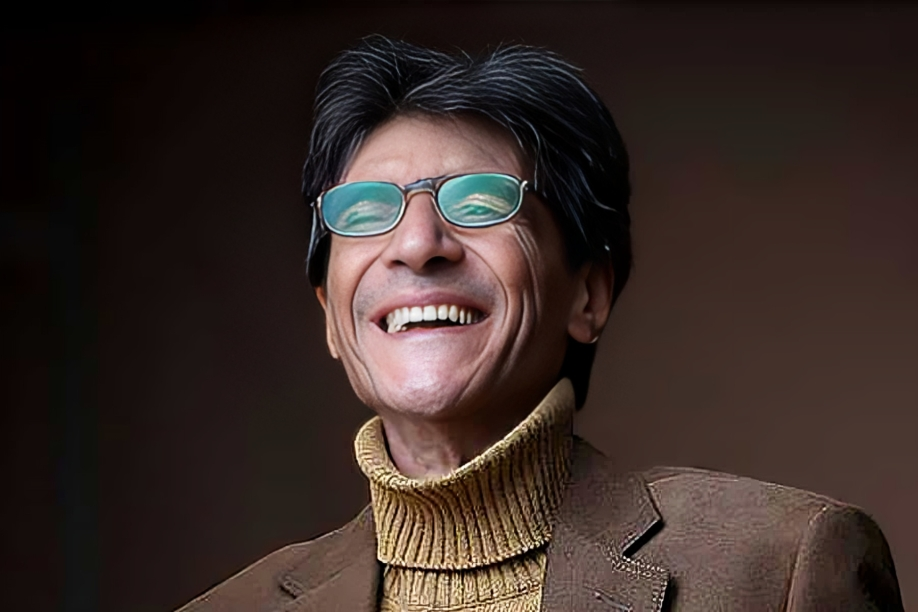
His work made the margins central—oil towns, workers, and those crushed by the 1953 coup—turning southern geography and post-coup disillusion into lucid, literary, defiant form.
Nasser Taghvai, the celebrated filmmaker, writer, and photographer—one of the most influential pioneers of Iran’s New Wave cinema—has died at the age of 84.
Born in Abadan, in southern Iran, in 1941, Taghvai’s name is inseparable from enduring works such as the television classic My Uncle Napoleon (Dā’i Jān Nāpel’on) and films including Tranquility in the Presence of Others, Sadegh Kordeh, The Curse, Captain Khorshid, and Unruled Paper. He passed away early Tuesday morning, October 14 (22 Mehr).
His wife, the actor Marzieh Vafamehr, confirmed the news in a deeply personal note:
“Nasser Taghvai—the artist who chose the hard path of living free—has now found release. Let us remember his flight. He loved plants; plant a tree for him. He loved light; light a candle for him. He loved white garments; wear white for him. He loved literature; read for him. He loved cinema; watch for him. Let us honor his memory not with grief, but through art, music, and light.”
A Career Shaped by Censorship
Despite a luminous body of work, Taghvai made only three feature films after the 1979 Revolution: Captain Khorshid (1988), Iran (1999), and Unruled Paper (2002). Many other projects—such as Zangi and Rumi and Bitter Tea—were halted mid-production or never approved.
He often described censorship as the defining constraint of his later life:
“The blade of censorship,” he said in a documentary, “has entirely prevented me from making films.”
He noted that even under the Pahlavi monarchy, while officials were not fond of his documentaries like The Wind of Jinn, they never stopped him from working. “In the current cultural climate,” he said later, “it’s simply impossible to do your work.”
Taghvai also denounced the deepening reach of literary censorship, saying in 2013:
“The censorship of books has become worse than in cinema. It has grown so monstrous it’s no longer about content—it polices the very words.”
In 2001, at the closing ceremony of the Fajr Film Festival, Taghvai famously refused the jury’s special prize for Unruled Paper:
“Please excuse me from accepting the Crystal Simorgh and the car purchase voucher that come with it,” he wrote in his withdrawal letter. “I have neither the money to buy a car nor the space in my small home to store such a grand award—especially if it is a ‘special’ one.”
His gesture became emblematic of his independence and indifference to official recognition.
“I Became Taghvai Through the Films I Didn’t Make”
Throughout his life, Taghvai remained politically and socially engaged. In December 2022, he joined hundreds of artists in signing an open letter demanding an end to the execution of protesters in the Woman, Life, Freedom uprising.
When a young filmmaker once asked for the secret of his success, Taghvai replied:
“Don’t think my place in cinema comes from the films I made. I became Taghvai through the films I didn’t make.”
It was a bitter acknowledgment of the works lost to censorship—but also a declaration of artistic integrity, the “difficulty of living free” that defined him.
From the Oil City to the Screen
To understand Taghvai’s cinema, one must return to his first stories—those written in Abadan’s heat and shadow. The Summer of That Year, composed a decade after the 1953 coup, transformed the refinery town into a stage where labor, loss, and resistance unfolded under the gray sky of post-nationalization defeat. As the critic Homa Nasir wrote, “Taghvai intertwined the pleasures and conflicts of workers with the shimmering geography of the South.”
This literary apprenticeship shaped the visual grammar of all his later films. The cadence of workers’ dialogue, the scent of burnt oil, the restless horizon of the Gulf—all reappear in Captain Khorshid, The Curse, and Tranquility in the Presence of Others. The realism of his camera was never neutral; it carried the melancholy of a generation “breathing the air of failure” after the coup, translating the moral fatigue of the 1950s into a new aesthetic of silence and endurance.
For Taghvai, literature was not merely background—it was, in his words, “the mother of cinema.” His Abadan became the cradle of Iran’s petro-modernity and its discontents: a geography where the oil economy, colonialism, and local life collided, giving rise to what scholars now call Iran’s first petro-fictional cinema.
Even his visual compositions—men on jetties at dawn, the hiss of refineries behind tired faces—echo the closing image of The Summer of That Year, where a ship departs, “its chimney silent, one hand shaking a hat in farewell.” In Taghvai’s work, the ship never stops sailing; it is the image of exile, persistence, and the endless summer of a wounded nation.
A Cinema Rooted in the South, and in Resistance
A child of Abadan and of Iran’s south, Taghvai carried the wound of the 1953 coup and the fervor of the working-class movements that followed. His cinema reflected a profound ethnographic eye and empathy for the dispossessed.
From the haunting ritual of The Wind of Jinn—a 1969 documentary co-created with writer and psychiatrist Gholamhossein Sa’edi, exploring Afro-Iranian spirit ceremonies in Bushehr—to The Curse and Tranquility in the Presence of Others, Taghvai turned social and political trauma into poetic allegory.
In an era when revenge and hero-making dominated Iranian cinema, he filmed Sadegh Kordeh as a story stripped of vengeance, reframing violence within its social landscape. In Captain Khorshid, inspired by Hemingway’s To Have and Have Not, he transformed the tale into a Southern Iranian parable of poverty and dignity—proof that oppression and survival transcend geography.
Had he made nothing else, Tranquility in the Presence of Others—with its unforgettable final scene—would still have secured his place among the immortals of Iranian cinema.
“This blank page still waits for you,” reads one of his final notes. “How many times will it turn, waiting for your return?”
Nasser Taghvai leaves behind a cinema of conscience—rooted in literature, wounded by censorship, and illuminated by the belief that even silence can resist.