
Iranian nature lovers must delay their hopes of having Mount Damavand, one of the country’s most distinctive features, recognized by the UNESCO World Heritage Centre. The head of Iran’s Cultural Heritage and Tourism Organization says the registration of Mount Damavand on the Natural and Cultural World Heritage list will not be possible unless several government bodies collaborate on the project. Massoud Soltanifar added that the presence of multiple governing bodies in the area is the biggest obstacle to placing Mount Damavand on the UNESCO list.
A similar lack of cooperation at the administrative level has already dashed the prospects of registering the Hera Forests in southern Iran on the World Heritage list.
Iran already has 17 ancient sites and historic buildings registered on the UNESCO list, but so far all efforts to register a natural site have failed.
Mount Damavand is already recognized as a national treasure in Iran, and Iranian nature lovers have hoped for a long time that it would be Iran’s first natural site to make it onto the UNESCO World Heritage list. However, according to the head of Iran’ s Cultural Heritage and Tourism Organization, UNESCO has steered clear of it due to the various administrations at work in the region and the lack of a unified plan of action.
The Many Mines Delving into Damavand
Mining in the region has been cited as another major obstacle to the recognition of Mount Damavand as a heritage site. Mining in the foothills of Damavand has seriously tarnished the natural view of this pristine landscape. While the government continues to issue permits for mining around Damavand, that activity is wiping out natural vegetation and causing widespread pollution; it is also creating a demand for more road construction, further altering the natural scenery.
 A number of reports indicating that several mining operations were taking place above the 2,200-metre level on Mount Damavand triggered widespread complaints, which forced the head of the judiciary to issue an order this month banning all mining activity above the 2,200-metre level and halting the movement of trucks and heavy machinery in the area. However, the wide expanse of the region and the influence of mine owners have made it difficult to implement the judicial order so far.
Damavand is a volcanic mountain, which makes it rich in lightweight rocks that are widely used in construction for insulation and to reduce the weight of buildings. Mining operations in Damavand are in effect cutting into the mountain’s surface using heavy machinery, which has left holes as deep as 20 metres in different areas.
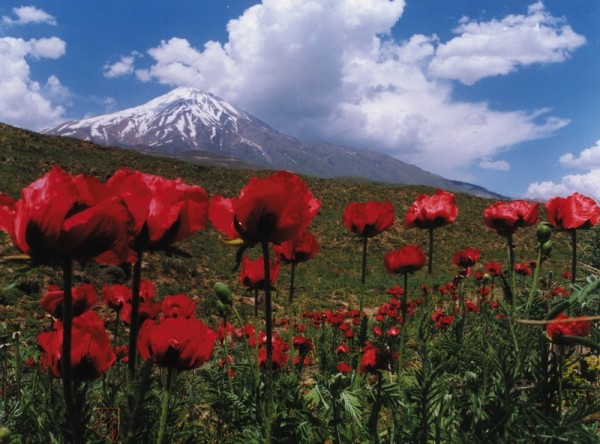
Damavand, which is the natural habitat of a wide variety of wild flowers such a tulips and poppies, has also suffered a serious loss of natural vegetation due to the mining activity.
History of Protests against Mining in Damavand
Four hundred trucks of volcanic rock are mined out of Damavand every day, and a new road has been built to facilitate the traffic. Residents of the region, especially the people of Rineh, have protested against the mining activity. In 1999, protests led to seven people being injured after a mine owner shot at them. As a consequence, one of the mines was shut down, but soon after, its operating licence was transferred to another entity and the mine reopened.
Environmental activists state that since volcanic rocks can now be fabricated in factories, there is no justification for further mining into Damavand.
Road Construction, Stock Grazing and Dumping Garbage
Mount Damavand was registered as a National Treasure in Iran in 2008, making it a protected site where any form of construction requires certain permits.
Despite the designation, road building, overt grazing and garbage dumping persist as serious problems threatening the Damavand site’s environmental integrity.
I n 2010, environment officials reported that a dirt path was being built at the 4,000-metre level of the mountain, aimed at granting easier access to some of the mountain’s most pristine areas, including Simorgh’s Nest, named after the legendary bird of Persian mythology. This is probably the last shelter for Mount Damavand’s wildlife.
Meanwhile, loads of garbage from neighbouring towns and villages are being dumped in certain areas of Damavand, polluting the waters and streams and destroying the natural scenery with non-biodegradable waste.
Iran's Efforts to Register Natural Sites
Iran has not yet taken much initiative to register the country’s natural and environmental sites on the UNESCO list. Some efforts were made to register the Hera Forests, but a lack of coordination among the Cultural Heritage Organization, the Ministry of Agriculture and the Department of the Environment has kept this natural resource from being recognized by the UNESCO committee.
A similar fate has befallen Mount Damavand, keeping it from gaining its due recognition as a World Heritage site because of a lack of initiative and coordination among the government bodies that are required to promote and present its case.