

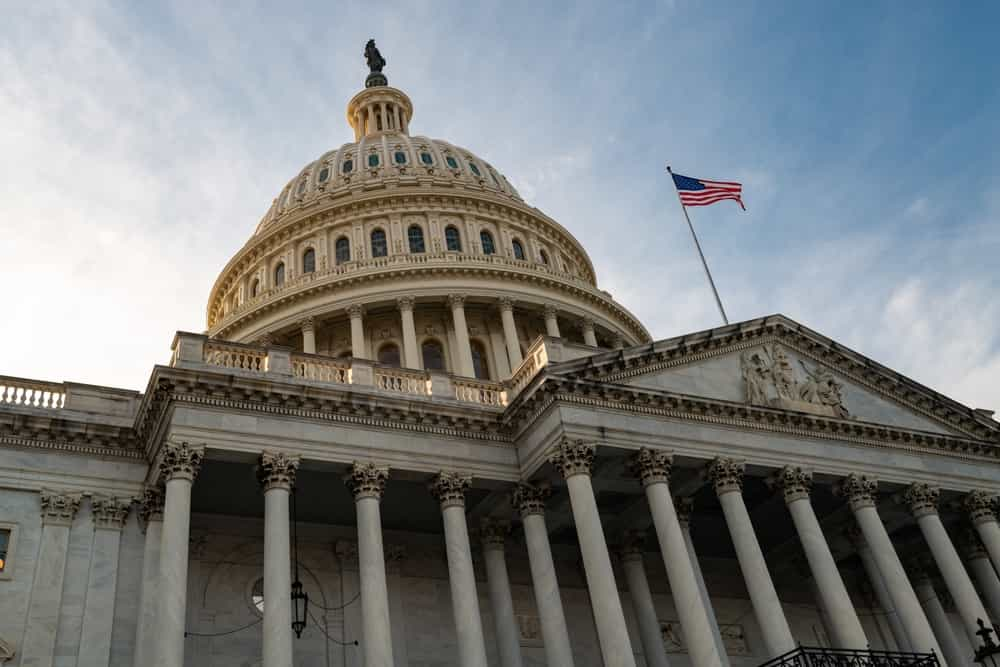
The US midterm elections on 3 November delivered a sweeping defeat to Donald Trump and the Republican Party. Democrats won control of both the House of Representatives and the Senate, ending Republican dominance of Congress and creating a major obstacle to the president’s domestic and foreign policies. The results crucially revealed the mounting political cost of the war against Iran, which has continued for more than eight months without a lasting settlement.
The war was not the only reason for the Republican defeat. Rising living costs, inflation, concerns over government corruption and opposition to Trump’s immigration crackdown, particularly the actions of Immigration and Customs Enforcement (ICE), all contributed to voter dissatisfaction. Yet the war against Iran has become closely intertwined with these economic grievances, particularly through higher fuel prices and disruptions to global energy markets.
According to an Associated Press election-day survey, around six in ten voters believed the United States had made the wrong decision in launching military action against Iran. Roughly one-third described the war as a crucial factor in their congressional vote, although concerns about the cost of living and corruption were more widespread.
Trump acknowledged that the war contributed to his party’s defeat, while continuing to defend his decision to launch military operations. Vice-President JD Vance went considerably further. “The reason we lost is the war,” he declared, arguing that the conflict had driven voters away from the Republican Party.
The elections therefore represent more than a routine change in congressional power. They have exposed a growing contradiction between the administration’s determination to maintain military pressure on Iran and the domestic political consequences of a conflict that has failed to deliver the decisive outcome promised by Washington.
Can a Democratic Congress Restrain Trump?
The Democrats’ victory will fundamentally alter the balance of power in Washington when the new Congress convenes in January 2027. For the remainder of Trump’s presidency, his administration will face stronger congressional scrutiny, greater resistance to its legislative agenda and potentially more serious challenges to its conduct of the Iran war.
Congress possesses important constitutional powers over government spending and military funding. Democrats could launch investigations into the conduct and costs of the war, challenge additional military appropriations and seek to restrict funding for operations that have not received congressional authorisation. The War Powers Resolution of 1973 also offers a potential mechanism for challenging the continuation of military hostilities without legislative approval.
The financial dimension is particularly significant. According to Pentagon figures provided to Congress, US military operations against Iran had cost approximately $47.1 billion by 16 October. Much of this expenditure has gone towards replacing expended munitions, particularly expensive missile interceptors, alongside operational costs and equipment losses. The continuing naval deployment in the Persian Gulf and the prospect of further military confrontation could push these costs considerably higher.
Yet congressional control does not automatically translate into the power to end the war. Trump retains substantial authority as commander-in-chief, particularly when ordering limited military operations. He can also veto legislation restricting military action, and overriding a presidential veto requires a two-thirds majority in both chambers.
There is also the question of timing. The newly elected Congress will not take office until January. Until then, Trump retains the political advantages of the outgoing Republican-controlled legislature.
His electoral defeat may therefore constrain his ability to sustain a prolonged war while leaving him considerable room to initiate another military operation before the new Congress assumes office.
Tehran’s Response: No Concessions, “Absolute Deterrence“
If the election results have increased pressure on Washington to find a way out of the conflict, Tehran’s immediate response suggests that a negotiated settlement will not come easily.
On 4 November, the anniversary of the 1979 seizure of the US embassy in Tehran, Mojtaba Khamenei issued a statement rejecting the idea that concessions to Washington could end American hostility towards Iran.
He warned that those who continued to hope for a change in American behaviour, whether through shifts between political parties or concessions to the United States, were profoundly mistaken.
Instead, Khamenei called for the continuation of his strategy of an “ever stronger Iran”, describing it as the only path towards achieving “absolute deterrence”. He also emphasised national unity and social cohesion and called on officials to pay greater attention to people’s livelihoods.
The statement is particularly significant in the immediate aftermath of the American elections. While the Republican defeat may create new opportunities for diplomacy, Khamenei’s message rejects the assumption that a change in Washington’s domestic balance of power will necessarily produce a more favourable relationship with Tehran.
His emphasis on deterrence suggests that the Islamic Republic continues to regard military strength, rather than diplomatic concessions, as its principal guarantee of survival.
The Revolutionary Guards reinforced this confrontational position on the same day. In a statement, the Islamic Revolutionary Guard Corps (IRGC) claimed that four oil tankers attempting to cross a prohibited route south of the Strait of Hormuz had been destroyed by naval mines. It also claimed to have stopped two other vessels and shot down a US MQ-9 drone over the waterway. These claims have not been independently verified.
The Guards further declared that their forces were prepared to deliver a “final blow” against the United States and Israel.
These statements demonstrate the continuing centrality of the Strait of Hormuz to Tehran’s military and political calculations. By threatening maritime traffic, Iran can impose costs extending well beyond the immediate battlefield, affecting global shipping, energy prices and the economies of countries dependent on Gulf exports.
But this strategy carries its own contradictions. Disruptions to energy markets have already contributed to the economic dissatisfaction that damaged Trump in the elections. Further escalation in the strait could increase domestic pressure on Washington to reach an agreement, but it could also provide the administration with a justification for renewed military action.
For the Islamic Republic, continued confrontation carries equally serious economic consequences. Inflation, declining purchasing power, unemployment and the prolonged disruption of trade have massively deepened the pressures on Iranian households. Khamenei’s call for improving people’s livelihoods offers no clear explanation of how those conditions can be addressed while the military confrontation and economic restrictions continue.
The question is therefore whether Tehran’s uncompromising rhetoric represents a fixed rejection of negotiations or an attempt to strengthen its bargaining position by demonstrating that it will not accept an agreement imposed through military pressure.
A Weakened Netanyahu and the Prospect of Diplomacy
The American elections have also coincided with political uncertainty in Israel. Following the Israeli parliamentary elections on 27 October, Benjamin Netanyahu’s political future remains unresolved. His Likud party emerged as the largest party, but the bloc supporting him secured only 53 seats in the 120-member Knesset, falling short of the 61 needed for a governing majority.
The opposing bloc, led by Gadi Eisenkot, won 48 seats, while Arab-led parties secured 19. The eventual composition of Israel’s next government therefore remains uncertain.
This matters because the American and Israeli governments have been closely aligned in their military campaign against Iran. A politically weakened Netanyahu may face additional difficulties in sustaining that alignment, particularly if Washington begins prioritising a negotiated settlement.
Yet a change of government in Israel would not necessarily produce a fundamental change in policy towards Iran. Significant sections of the Israeli political establishment support military pressure on Tehran, even when they disagree over Netanyahu’s leadership.
Meanwhile, regional governments have strong reasons to favour an end to the confrontation. The disruption of trade and energy infrastructure, uncertainty surrounding navigation through the Strait of Hormuz and the possibility of further attacks have imposed considerable economic and security costs on Gulf countries.
The central obstacles to an agreement nevertheless remain unresolved. Washington continues to seek restrictions on Iran’s nuclear programme and guarantees concerning maritime security. Tehran insists that sanctions relief, an end to the American naval blockade and the restoration of its economic access must form part of any settlement.
The American elections may strengthen the political incentives for diplomacy without resolving these substantive disagreements.
Between Negotiations and Another Military Escalation
Trump now faces two competing pressures. On the one hand, the elections have demonstrated the domestic costs of continuing the war. A negotiated settlement could allow him to claim that the United States achieved its security objectives while bringing an increasingly unpopular conflict to an end.
On the other hand, accepting an agreement without substantial Iranian concessions could be interpreted by his political opponents and supporters of the war as a strategic failure.
This creates a dangerous possibility. Rather than immediately pursuing negotiations, Trump could attempt another short, intensive military campaign designed to force Tehran into accepting more favourable terms before the new Congress assumes office.
Such a strategy would rest on the assumption that renewed American military superiority could produce concessions that earlier operations failed to secure. Yet Tehran’s latest declarations suggest that another attack might instead provoke further retaliation, particularly against maritime traffic and American military installations in the region.
The prospect of a swift operation followed by a declaration of victory therefore depends on an uncertain assumption: that Iran would absorb another round of attacks without expanding the conflict.
At the same time, the Islamic Republic faces its own strategic dilemma. Its leaders may interpret Trump’s electoral defeat as evidence that their strategy of endurance and deterrence is working. But an American president weakened at home is not necessarily an American president prepared to compromise. Tehran could miscalculate if it assumes that the loss of congressional support has deprived Trump of the capacity or willingness to escalate militarily.
The election has thus created a new political situation without resolving the underlying conflict. Washington has become more constrained domestically, while Tehran continues to present resistance and military deterrence as indispensable to its survival.
For Iran’s population, neither outcome offers an automatic escape from the present crisis. A settlement that leaves sanctions and economic restrictions substantially intact would do little to reverse the deterioration in living conditions. Another military offensive, meanwhile, would deepen the destruction and insecurity already imposed on society.
The coming weeks will test whether electoral defeat pushes Trump towards a negotiated exit or encourages another attempt to secure through military force what Washington has so far failed to achieve. They will also test whether Tehran’s insistence on deterrence leaves room for a political settlement.
The war has become a major liability for the White House, but that does not necessarily mean peace is approaching. The risk is that both governments interpret the other’s vulnerabilities as an opportunity to raise the stakes, prolonging a confrontation whose costs are increasingly borne by ordinary people.