

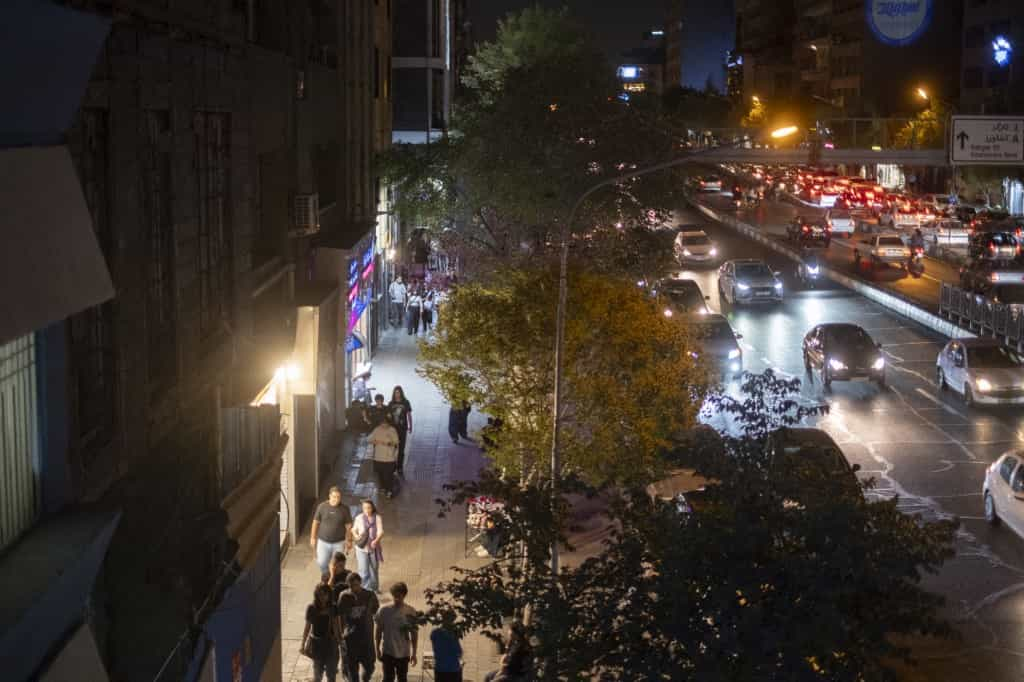
In recent years, patterns of drug use in Iran have changed in striking ways. The abundance of drugs and the ease with which different substances can be obtained have made resisting drug use more difficult than ever, particularly against a backdrop of widespread social hardship. Almost any drug can now be found in or around many public parks. Yet the ways in which people obtain drugs and dealers sell them have changed considerably. This report focuses specifically on substances that, in theory, should be more difficult to obtain, such as crystal methamphetamine, commonly known in Iran as shisheh.
From Executions to Going Underground: The Harsh Realities of Criminalising Addiction in Iran
Following the 1979 revolution, the authorities intensified their crackdown on people who used or sold drugs, particularly after Sadegh Khalkhali took charge of the revolutionary courts in 1980. Khalkhali’s notorious tendency to impose and carry out severe punishments disproportionate to the offences committed created such turmoil that the country’s drug problem appeared increasingly intractable. After Khalkhali’s removal, the pressure on drug users eased somewhat.
In the early 1980s, dealers in certain parts of Tehran used distinctive signals to identify themselves to potential customers. The substances available were generally opium and other morphine-related opiates, with cannabis products appearing less frequently.
During those years, Iranian society was also preoccupied with the Iran–Iraq War and intense political rivalries, which considerably reduced the pressure on drug users and small-scale dealers. In Tehran, street-level drug dealers could be found around the Grand Bazaar, in an area extending south to Shush Street, west to Hafez Street, east to 17 Shahrivar Street and north to Amir Kabir Street. Most people seeking drugs knew their regular dealers and went directly to them. But Tehran also attracted travellers who came to the capital out of necessity, creating demand among people unfamiliar with the local networks.
As a result, some dealers began operating around Naser Khosrow Street and Toopkhaneh Square. They used subtle signals that potential buyers could easily recognise. A nod of the head, for instance, might be enough to establish contact. If the other person nodded back, the message had been received and the transaction could proceed.
Some dealers held a handful of coins, repeatedly moving them around in their palms. A potential buyer could recognise the signal from a distance and approach. If eye contact and a nod confirmed their intentions, they would move into one of the narrow alleyways hidden from public view to complete the transaction.
At the time, women who used drugs remained largely hidden inside their homes, much as they were confined to the private sphere in other aspects of life. Their invisibility helped perpetuate the misconception that addiction was exclusively a male problem. But as the number of people using drugs rose sharply, there was increasingly little left to conceal.
The Sudden Explosion in Drug Use
The reasons behind the dramatic increase in drug use during the mid-1990s require serious investigation. One indication of the scale of Iran’s drug problem can be found in the striking figures published by the Abdorrahman Boroumand Foundation.
Between 1979 and 2004, more than 2.5 million people were imprisoned in connection with drug-related offences. Remarkably, around 911,000 were imprisoned for drug addiction, while approximately 1.6 million were imprisoned for selling drugs or acting as intermediaries. In other words, the number imprisoned for dealing or facilitating drug sales was somewhat less than twice the number imprisoned for addiction itself.
The large number of drug-related arrests during those years gave rise to suspicions that the authorities’ harsh approach was intended not only to punish people who used drugs, but also to identify them, open files on them and compile a database containing their personal information.
One story illustrates how widespread such records became.
A middle-aged man was sent to court over a traffic violation. While an official was completing his paperwork, he was asked whether he had any previous convictions. The man replied that he had once been arrested on a drug-related charge.
“When was that?” the official asked.
The man thought for a moment before answering, “Nearly thirty years ago.”
The official smiled and said, “I won’t mention it here.”
Then he added, “Back then, practically everyone had a drug-related file.”
By the early 2000s, obtaining drugs had become considerably easier than it had been during the 1990s. Users no longer needed to visit the traditional dealing areas. They could simply go to the vicinity of bus terminals or railway stations and obtain the substances they wanted.
This growing availability led social activists to suspect that hidden networks were involved in bringing drugs into the country and overseeing their distribution, while leaving no trace of their activities.
The gradual but alarming spread of HIV was the warning sign that made continued concealment impossible. The virus spread through different patterns of transmission over time, eventually prompting the responsible institutions to reconsider their approach. Rather than treating addiction exclusively as a criminal offence, they began to consider it a medical condition requiring treatment.
Poverty, the sharing of contaminated syringes, the absence of preventive education and high-risk sexual practices all contributed to a new wave of HIV infections. At the same time, sexual relationships outside officially sanctioned arrangements were themselves criminalised.
These circumstances produced new cycles of illness, isolation, suffering, addiction and painful deaths, perpetuating the seemingly endless hardships of poverty and desperation.
Women who used drugs faced additional dangers. Beyond the difficulties experienced by people with addiction more generally, some were driven into sex work by circumstances that left them with little choice.
In informal settlements lacking adequate sanitation and preventive healthcare, women who were sometimes forced to exchange sex for enough money to obtain a single dose faced multiple risks. These included HIV transmission to sexual partners and, in cases of pregnancy, to their unborn children, as well as unsafe abortions and exposure to sexual violence.
Drug dependency, however, is not something that can be resolved simply by explaining its dangers or delivering moral lectures.
Alongside one of the major motorways south of Tehran, heavy concrete traffic barriers have been installed to prevent vehicles from stopping on the roadside. Yet as darkness falls, silhouettes emerge around small fires. A line of cars can be seen parked beyond the barriers, having passed through gaps between them.
This has become one of the area’s principal gathering places for people who come to use drugs.
Rising drug prices have given rise to new ways of selling small quantities: individual inhalations of crystal meth, single lines of heroin and tiny, mung-bean-sized portions of opium.
Someone with very little money may make their way to one of these locations however they can. Unable to afford a gram of methamphetamine, they can pay for just a few inhalations. Others can purchase a line or two of heroin or consume it by smoking.
Another important gathering place for this kind of short-term drug use is located beside a different Tehran motorway.
At both sites, the main identifying feature is fire. Lighting a fire in the middle of summer is unusual enough to attract the attention of people passing by.
According to the report, the main reason people gather at these locations is the sharp rise in drug prices. Buying and consuming small quantities on the spot allows them to stave off the distress of withdrawal, an especially pressing concern for people dependent on heroin or methamphetamine.
Similar gathering places have also emerged along routes towards Shahriar and Malard, west of Tehran.
What’s Hidden in an Espresso Cup?
On 15 Khordad Street in Tehran, a man approaches a newspaper kiosk, visibly out of breath.
“Brother, who’s selling around here?” he asks.
The kiosk owner, apparently unconcerned that several people can hear the conversation, replies, “What are you looking for?”
“Crystal meth,” the man says.
The kiosk owner steps outside and points towards a nearby location. The man sets off in the indicated direction, walking more purposefully than before.
Someone who has overheard the exchange asks the kiosk owner, “Aren’t you afraid they’ll come and arrest you too?”
The kiosk owner laughs.
“Arrest who?”
Drugs have also become readily available in small neighbourhood parks.
A middle-aged woman describes how she once went to a small park between the apartment blocks where she lived, hoping to escape the noise of a house full of guests and enjoy a little peace.
“I was sitting in a quiet, dimly lit corner of the park when a woman came over to my bench and held out an old Nokia mobile phone, asking me to take it. I had no idea what she wanted. She kept saying the phone was broken and asking me to have a look at it.”
The woman refused to take the phone.
The stranger then turned it around and showed her the battery compartment. Hidden inside was a small package of opium. She had apparently mistaken the woman for an inexperienced buyer and was trying to persuade her to make a purchase.
When she realised the woman was not interested, she remained entirely unconcerned.
“I’ve got other stuff too, if you want,” she said.
The woman says she has not dared send her children to that park since that evening.
“They’re all around us,” she says. “You can’t even buy water that easily.”
The spread of drug use has reached deeply troubling proportions.
People who use drugs are generally divided into two broad categories: those living with addiction and recreational users.
On a street near one of central Tehran’s busiest thoroughfares, a young woman and man approach a street vendor and ask whether there is a café nearby where they can get some coffee.
“Go round the next corner and into the alley,” the vendor tells them. “There’s a cosy little café. They’ll give you a coffee that’ll keep you going for 24 hours.”
“How?” the young woman asks.
The young man takes her hand and answers before the vendor can speak.
“He means methadone.”
The exchange raises a troubling possibility: that some people might order coffee without knowing it contains another substance and attribute any unusual effects to caffeine. The report speculates about how many customers might unknowingly consume drugs in this way.
If such practices are occurring, they would suggest the emergence of a third category of drug users: people who consume substances without even knowing they are doing so.
The allegation has also become the subject of videos circulating on Instagram.
Finding Somewhere to Use Drugs Can Be Harder Than Finding the Drugs Themselves
For people living with addiction, finding somewhere to consume drugs has often been a greater concern than obtaining the substances themselves.
One striking development in recent years has been the proliferation of places where drugs can be consumed, including a new phenomenon: mobile drug-use spaces.
Because people using heroin or methamphetamine may need a private place for only a few minutes, some individuals have begun renting out such spaces and charging by the minute.
Those offering these services operate near drug-dealing areas. They approach potential customers directly. If someone needs somewhere to consume drugs, they can get into a car, which then drives several streets away. Once a suitable location is found, the driver pulls over and allows the passenger to finish using the substance.
The charge is calculated according to the total number of minutes spent in the vehicle and the distance travelled. Prices vary considerably depending on the customer’s appearance, whether they are new or experienced users, and the type of car.
In newer, more expensive vehicles, rates can reach 300,000 tomans per minute. In ordinary cars, they can be as high as 150,000 tomans per minute.
Customers using these mobile spaces are often bazaar traders who need to relieve their withdrawal symptoms before returning home.
One notable aspect of this arrangement is the relationship that develops between the drug user and the person providing the space — the car owner. A customer satisfied with the owner’s behaviour is more likely to return, creating an ongoing relationship between the two.
The situation of women using such mobile spaces is particularly concerning.
A report published by the Iranian daily Shargh described the changing circumstances of women gathering at drug-use sites following the war:
“Since the 40-day war, the presence of middle-aged women at these gathering places has increased. These are women who previously led ordinary lives, some of whom did not even use drugs. But severe economic pressures and the absence of social services have gradually pushed them towards these places, where they face a heightened risk of rapidly developing addiction.”
(Source: Shargh, 2 September 2026, “Middle-Aged Women, Newcomers to the Margins of Addiction”.)
There is another deeply disturbing aspect to this story.
There appears to be scarcely any part of this vast drug market of which law-enforcement officers are unaware.
They know why camping tents have been pitched beside motorways. They know why concrete barriers have been moved aside and why rows of cars are parked beyond them.
They know why groups of people light fires on elevated ground overlooking a motorway on warm summer evenings.
And they are familiar with many of the drug dealers operating around Tehran’s bazaar: from the crystal meth dealers near Mokhber al-Dowleh to the heroin dealers at the southern end of Khayyam Street and the opium sellers around Marvi Street.
What prevents the authorities from confronting this crisis remains the central unresolved question.