

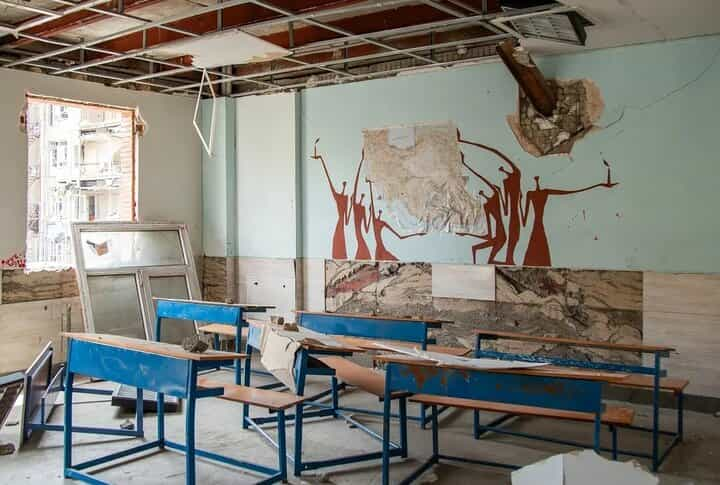
If war breaks out again, where will millions of Iranian schoolchildren take shelter? Schools in Iran have neither access to an extensive network of properly equipped shelters nor an effective air-raid warning system. Meanwhile, the infrastructure for online education continues to suffer from serious shortcomings. Despite the threat of renewed attacks, the government has made the continuation of in-person education dependent on identifying high-risk areas. But how can anyone know in advance which school might lie in the path of a missile?
With the start of the new academic year, millions of students across Iran have returned to school, even as the possibility of renewed war remains. The Ministry of Education has said it will close schools in areas deemed at risk if necessary. But this promise raises a fundamental question: in a war where the timing and location of potential attacks cannot be known in advance, how can officials determine which schools are at risk and which are not? Missiles and drones do not announce their intended targets to city residents before striking. Even if military facilities and certain infrastructure sites are the most likely targets, the experience of the two previous wars involving Israel and the United States against Iran shows that residential neighbourhoods and other urban areas cannot be considered safe. Indeed, some missiles may strike civilian areas and ordinary people, whether accidentally or deliberately. Even bombs and missiles that accurately hit military or government targets can cause civilian casualties through shrapnel and blast waves.
Although schools remain open for in-person teaching across most of Iran, political and security officials in Hormozgan province have ordered all schools, at every educational level, to switch to remote learning. On Saturday, 10 October 2026, Ahmad Nafisi, the provincial deputy governor for political, security and social affairs, announced that all schools in Hormozgan would operate remotely from Sunday, 11 October. Similarly, on 8 October, the Kish Free Zone Organisation announced that, under a directive from the local Security Council and according to the Kish education authorities, schools on the island would continue teaching remotely that week, as they had during the previous two weeks. Classes would be conducted through Shad, Iran’s official online education platform.
The cautious and sensible decision taken by Hormozgan’s political and security officials should arguably be extended to many other provinces, perhaps even most of Iran. The available signs suggest that another war may be imminent, while most political and military analysts expect any new conflict to be considerably more intense than the previous two.
During the Iran–Iraq War, air-raid sirens warned the population of incoming attacks. From the moment the dreaded sirens began to sound until bombs or missiles struck somewhere in Tehran or other cities far from the border, people generally had enough time to move to a relatively safer location. During the two most recent wars, however, no such air-raid warning system was available. Israel did sometimes announce that it intended to strike particular neighbourhoods in Tehran, especially during the 12-day war, but these warnings were of limited use because internet access had been cut off. As a result, ordinary people, most of whom had no desire to become martyrs, could do little more than hope for good fortune or rely on the attacking forces’ supposedly precise targeting. Yet whether warnings come from government sirens or announcements by the attacking forces, if decisions to close schools are made only after the areas targeted for attack have been identified, might those decisions come too late to prevent harm?
Parents’ concerns are not limited to the possibility of a missile hitting a school building. Children must leave home, travel to school, sit in school buses or on public transport, and spend hours in environments that may lack adequate protection. In the event of an attack, even this daily journey can expose them to danger.
More importantly, Iran lacks an extensive network of purpose-built, properly equipped public shelters to protect civilians from bombardment. During the 12-day war in June 2025, the government announced that metro stations, mosques and schools would be made available as places of refuge. Tehran’s metro stations were also officially designated as shelters accessible around the clock. Nevertheless, reports emerged of some stations refusing to admit people seeking shelter. Moreover, metro stations and ordinary public buildings were not designed to withstand every form of bombardment.
Under these circumstances, in-person schooling cannot continue simply on the assumption that children will be able to reach somewhere safe when an attack occurs. Towards the end of the Iran–Iraq War, construction began on shelters in some Tehran schools to protect pupils from Iraqi air raids. But the war ended less than two years later, and the government saw no need to continue equipping schools with shelters. When schools have no shelters and the routes children take across cities also lack adequate protective infrastructure, alternative ways of reducing their exposure to avoidable dangers must be considered.
One such alternative is online education, a measure Iran was forced to adopt during the spring of 2026. Yet that experience demonstrated that moving education online requires more than simply announcing school closures. Problems with the Shad platform, technical limitations and difficulties accessing the internet made it hard for many students to continue their education.
In spring 2026, technical failures affecting Shad and internet shutdowns disrupted access to classes for some students. The Ministry of Education has announced plans to expand the platform’s infrastructure. According to a report published in September 2026, Shad’s capacity was to be strengthened by adding 300 servers. At that point, 140 servers had been purchased, with their installation scheduled to begin in late September and the remaining servers expected to become operational by 21 November 2026. These figures show that improvements to the online education infrastructure are still under way. Simply declaring Shad ready does not guarantee that every student will have reliable access.
Rather than providing a reason to abandon online education, this experience demonstrates the need to strengthen it and address its shortcomings. If officials are aware of the possibility of another crisis, why wait until an attack occurs before tackling the technical and practical problems of remote learning? Improving the educational platform, providing alternative ways to access teaching materials and ensuring that students without internet access or digital devices are not excluded are all measures that should be taken before a crisis begins.
Ukraine’s experience also demonstrates that education during wartime requires advance planning. In cities such as Kyiv, some schools have been equipped with underground shelters that allow in-person classes to continue. In Kharkiv and Zaporizhzhia, underground educational facilities have also been established so that children can continue their studies in more protected environments. In areas where such facilities are unavailable or security conditions make attendance unsafe, online education remains one of the main alternatives.
Of course, Ukraine and Iran differ in their infrastructure and the conditions under which they face war, and one country’s educational policies cannot simply be transplanted into another. But one lesson from Ukraine is clear: maintaining education during wartime must not mean disregarding basic safety requirements. In many Ukrainian schools, in-person teaching depends on the availability of a suitable shelter or other protective space. Iran, where such infrastructure is not widely available, must take this difference into account when making decisions.
Some may argue that online education cannot match the quality of classroom teaching, and that depriving children of the school environment can have educational and psychological consequences. These concerns are real in peacetime, but in wartime they cannot take precedence over children’s safety. Although not every family has reliable internet access or the devices required for online learning, safety must come before education.
The issue, in fact, is not a choice between good and bad education. It is how to preserve children’s right to education without exposing them to avoidable danger. The shortcomings of online education must be addressed through planning and investment, rather than used to justify ignoring the risks of in-person schooling. Children may still be vulnerable to attacks while at home, but temporarily suspending school attendance can reduce the dangers associated with daily travel across cities and the gathering of large numbers of children in educational facilities under bombardment. Remote learning would also allow families to leave larger cities, which are more likely to face attacks.
The Ministry of Education must therefore do more than promise to close schools in dangerous areas if necessary. It needs to explain the criteria on which such decisions will be based. How can the ministry distinguish between safe and unsafe areas before an attack occurs? What plans does it have for schools without adequate protective facilities? Is the infrastructure in place for a rapid transition to online education? And what arrangements have been made for students without internet access or digital devices? Keeping schools open during wartime is not evidence that conditions are normal. The state’s responsibility extends beyond ensuring that classes continue. As the most basic principles of political science make clear, one of the state’s fundamental duties is to maintain order and security. If air defences cannot adequately protect children, online education can offer at least a degree of protection. There is a difference between accepting unavoidable dangers and exposing citizens to risks that could be reduced.
Children are not responsible for starting or ending wars. They should not have to pay the price for a failure to plan ahead. Protecting schoolchildren’s lives must not depend on officials being able to predict where missiles will land, because such precise predictions are fundamentally impossible. The real question is not whether schools can be kept open during wartime. It is what measures can be taken to ensure that education continues without compromising children’s health and safety. The answer must be ready before an attack occurs, not afterwards.