

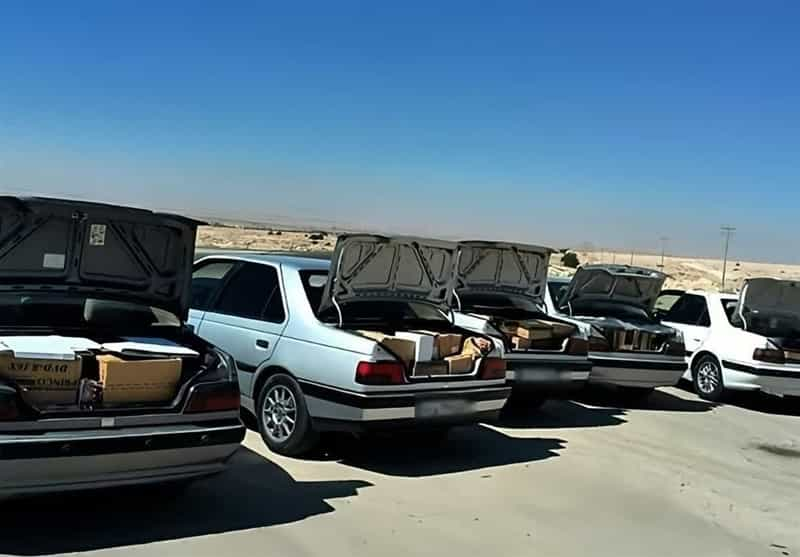
Known in Iran as shutis, these drivers transport goods, often smuggled or moving outside official distribution channels, from ports and border towns to other cities. This field report follows three drivers whose livelihoods depend on these hazardous journeys.
“You used to tell yourself the risk was high, but the money made it worthwhile. Now there aren’t as many loads as before, the money isn’t worth what it used to be, but the danger is just the same.”
This is how Javad, a shuti driver in Bushehr, describes the lives of people caught between unemployment, deadly roads and the informal economy. War, inflation and disruptions to trade have reduced their incomes, but the dangers of police pursuits, accidents and vehicle seizures remain. Like kolbars (border porters who carry goods across mountainous routes) and fuel carriers, shuti drivers sometimes risk their lives simply to earn a living.
Shuti driving is a form of precarious work that has expanded in recent years, particularly in Iran’s southern and border regions. The work carries enormous risks: police pursuits, accidents, the confiscation of vehicles and cargo, and sometimes the loss of everything a driver owns. Alongside kolbars and fuel carriers, shuti drivers form part of Iran’s informal economy. Some enter this work in pursuit of higher earnings, others out of sheer necessity. For all of them, every journey could be their last. Javad, Kasra and Shahram, three shuti drivers from Iran’s southern and western provinces, describe life on the road.
Until a few years ago, reports of deaths among Iran’s informal border workers focused largely on kolbars and fuel carriers. Now shuti drivers must be added to that list. To evade police checks and confiscation, they sometimes drive at extremely high speeds. What appears to be a job involving little more than a car and a journey of a few hours can end in a police chase, a crash, the seizure of a vehicle, mounting debt or death.
Official figures from Iran’s traffic police show that during the Iranian calendar year 1404 (March 2025–March 2026), 358 people were killed and 513 injured in accidents involving shuti vehicles. According to the head of the highway police, the authorities considered 92 per cent of those killed and 90 per cent of those injured to have been responsible for the accidents in which they were involved. Fatalities fell by 12 per cent compared with the previous year, but the figures nevertheless demonstrate that shuti driving is not merely an economic or law-enforcement issue. It is also a serious road safety problem.
These figures should be considered alongside the situation facing kolbars and fuel carriers. According to Kolbar News, 26 kolbars were killed and 31 injured during the same Iranian calendar year, with 77 per cent of the recorded deaths and injuries resulting from shootings by military forces. These figures are based on incidents documented by the organisation and do not necessarily represent a comprehensive official count.
Statistics concerning fuel carriers also vary according to the source and method of recording. The annual report of Human Rights Activists in Iran for the Iranian year 1404 documented 23 fuel carriers killed and 13 injured by gunfire from military forces. It also recorded 84 fuel carriers involved in incidents arising from military pursuits or road accidents connected to their work. Of these, 76 were killed and eight injured.
These figures cannot simply be added together, nor can the dangers of all three occupations be measured using a single formula. Taken together, however, they reveal how, in parts of Iran, the distance between earning a living and risking one’s life has become dangerously narrow.
Javad is 28, single and from Ahram in Bushehr province. He has been working as a shuti driver for eight years, using a Samand manufactured in 2007–08. He explains that neither a passion for speed nor the thrill of escaping the police drew him into the occupation. It was the absence of other employment.
“There were no decent jobs. You couldn’t find anything with a steady income. So, like many others, I got into this line of work. Especially because back then, I mean five or six years ago, shuti driving was a well-paid job.”
Shuti drivers have no fixed income. Their earnings depend on the type of cargo, the route, the number of journeys and the level of risk involved. One published report on shuti drivers in Bushehr put the payment for transporting a single load at around six to seven million tomans and reported that drivers were sometimes required to provide guarantees worth 100 million tomans before being entrusted with certain cargoes. According to the drivers interviewed for this report, in recent years those who secured more loads and completed several journeys a month could earn around 100 million tomans or even more. For a young person in a small town, that was an attractive sum compared with wages in many formal occupations.
But high earnings did not necessarily translate into more money in a driver’s pocket. Vehicle costs, repairs, petrol, cargo guarantees, fines, confiscation and the possibility of losing the car altogether all had to be taken into account. Javad says these earnings were what persuaded many drivers to accept the risks. Now, however, circumstances have changed.
The 12-day war in June 2025, followed by the 40-day war in 2026, disrupted the movement of goods and port operations, reducing the number of loads available to shuti drivers. The subsequent US naval blockade made matters worse. Maritime trade was disrupted, leaving some cargo stranded at ports and delaying other shipments. For drivers whose income depends directly on the number of loads they transport, any disruption to maritime trade means fewer journeys and less money.
“There are far fewer loads now. Before, you might get several jobs a month and make good money. These days, sometimes there’s simply nothing to transport. And even if you manage to earn 100 million tomans in a month, with all this inflation and rising prices, there’s nothing left. The car, tyres, repairs, household expenses — everything has become more expensive. And every time you go out, you’re taking a risk. You could crash, have your car confiscated or never come home. A hundred million tomans isn’t worth what it was a few years ago.”
For shuti drivers who once considered the high earnings sufficient compensation for the dangers, the calculation has fundamentally changed. There are fewer loads, and the money they earn has lost value, while the risks remain unchanged.
As Javad puts it:
“You used to tell yourself the risk was high, but the money made it worthwhile. Now there aren’t as many loads as before, the money isn’t worth what it used to be, but the danger is just the same.”
Kasra is 30 and lives in Farashband. He has worked as a shuti driver for almost ten years. Married with one child, he drives a Peugeot RD manufactured in 2011–12. He says that if people knew in advance what their lives would become, they might never enter this line of work. The problem is that many have very few alternatives when they make that decision.
Kasra has tried several times to leave shuti driving behind. He even opened a clothing shop, using money raised by selling his wife’s gold jewellery. But the business failed, and he lost the investment. Eventually, he bought another car on instalments and returned to the road.
For Javad and Kasra, the road is not merely a workplace; it is part of everyday life. They collect cargo, know the routes, identify places where police checks are more likely and draw on other drivers’ experiences. Yet familiarity offers no guarantee of safety. Sometimes a police chase lasting only a few minutes is enough to wipe out the earnings of several months.
Kasra recalls one such pursuit. On the road between Bandar-e Deyr and Kangan, police began chasing him, and he crashed while trying to escape. He lost both his car and the cargo and was subsequently forced to borrow money to cover the losses. For someone whose entire capital consists of a vehicle, a crash is not simply a road accident. It can mean losing a livelihood, falling into debt and starting again from nothing. It can even mean losing someone close, as Javad did when a friend was killed on those same roads.
“He was 23. He crashed during a police chase and died right in front of me.”
For Javad, his friend’s death is not merely a memory. Every time he gets behind the wheel, he knows that the danger he describes has already claimed the life of someone who once drove alongside him on these roads.
Shahram, another shuti driver from Pol-e Dokhtar in Lorestan province, tells a similar story. Over time, he has moved beyond driving alone and begun working with several other drivers, acting as an intermediary or taking responsibility for cargo on behalf of its owners. His experience reveals another form of danger: the risks do not come only from the police, the roads or accidents. Sometimes they emerge from within the very networks in which shuti drivers operate.
According to Shahram, one driver working for him once made off with a consignment he had been entrusted to transport. The incident had been carefully staged to look like a roadside robbery. The driver claimed to have been attacked and had even fired shots at his own car to make the story more convincing. The cargo disappeared, and the driver appeared to be the victim of a robbery.
But Shahram faced a more serious problem: he could not easily report the theft to the authorities. For someone involved in an informal goods transport network, going to the police and explaining that a driver had stolen a consignment entrusted to him could result in a criminal investigation against Shahram himself. Under such circumstances, financial disputes and theft cannot be pursued through the ordinary legal channels available to people in formal employment.
This is the hidden side of shuti driving, rarely visible in its romanticised or heroic portrayals.
In popular songs, the shuti driver is someone who conquers the road, fears no danger and risks his life to earn an honest living. The song “A Shuti Knows No Fear, a Shuti Earns an Honest Living”, performed by Saeed Mohammadi, captures precisely this image.
The song has circulated widely on social media in recent years, particularly among audiences familiar with this world. Another song, by Qasem Fazeli, presents a similar image of a driver getting behind the wheel and risking his life to earn an honest living.
The reality, however, is far more complicated. A shuti driver may simultaneously be in debt, accused of wrongdoing, the victim of theft, at risk of having his vehicle confiscated and liable for losses suffered by the cargo owner, without clear legal protection in many of these situations. Nor are relationships among shuti drivers based solely on camaraderie.
Javad speaks of drivers helping one another on the road. If someone’s car breaks down or they find themselves in a dangerous situation, it is often another driver who comes to their aid. Yet these informal networks also generate competition and distrust. Where cargo, money and vehicles are involved, and no formal contracts exist, disagreements can turn into threats, debt or the disappearance of goods.
Elsewhere in Iran, kolbars and fuel carriers face different forms of the same insecurity.
Kolbars, who carry goods across mountainous border routes, may face gunfire, falls, freezing temperatures or avalanches. Fuel carriers travel in vehicles loaded with fuel, where a crash or police pursuit can cause a deadly fire. Reports covering 2025 documented dozens of deaths and injuries among fuel carriers as a result of shootings and road accidents.
Kasra’s observation that “kolbars and fuel carriers don’t want to be doing this work” must be understood in this context.
This does not mean that every driver is blameless or that their activities are necessarily legal. Transporting smuggled goods, speeding and evading law enforcement can also endanger others. Traffic police figures also point to the serious risks associated with shuti driving. But the existence of hundreds of casualties does not mean the problem can be explained simply by labelling these people “offending drivers”.
Kasra says many shuti drivers would leave the occupation if they could find other work. He, too, would be willing to give up the road if a suitable opportunity arose.
Javad would not recommend the job to his nephews or younger relatives. The experience of losing friends, suffering accidents, being arrested and living with constant anxiety is not something easily forgotten.
And yet they keep returning to the road. Not because shuti drivers are in love with danger, but because, in an economy where the cost of living continually rises and secure formal employment with a reliable income is not available to everyone, taking risks can become part of the economic calculation. Now even that calculation has changed.
The 12-day war, the 40-day war and the subsequent naval blockade disrupted the movement of goods entering through southern Iran. Transport workers report stalled shipments and growing difficulties in maritime trade, while recent reports indicate that Iran’s maritime trade remains under pressure from the blockade and continuing insecurity.
For shuti drivers, the consequences can be summed up in one simple sentence: “There’s no cargo.”
Fewer loads mean fewer journeys. Fewer journeys mean less income. And as earnings decline, the risks that drivers once accepted in exchange for relatively high pay no longer make the same economic sense. Perhaps this is why shuti driving, kolbari and fuel carrying cannot be understood solely through labels such as “smuggler” or “victim”. Between those two words are people who leave their homes in the morning, start their cars, collect their cargo and have no idea whether they will return that night.
This dangerous way of life has now also found its way onto the cinema screen. The film Escort, directed by Yousef Hatamikia and starring Amir Jadidi and Hoda Zeinolabedin, is currently screening in cinemas across Iran. Centred on the experiences of shuti drivers, it offers audiences a human and believable portrayal of the difficulties they face.