

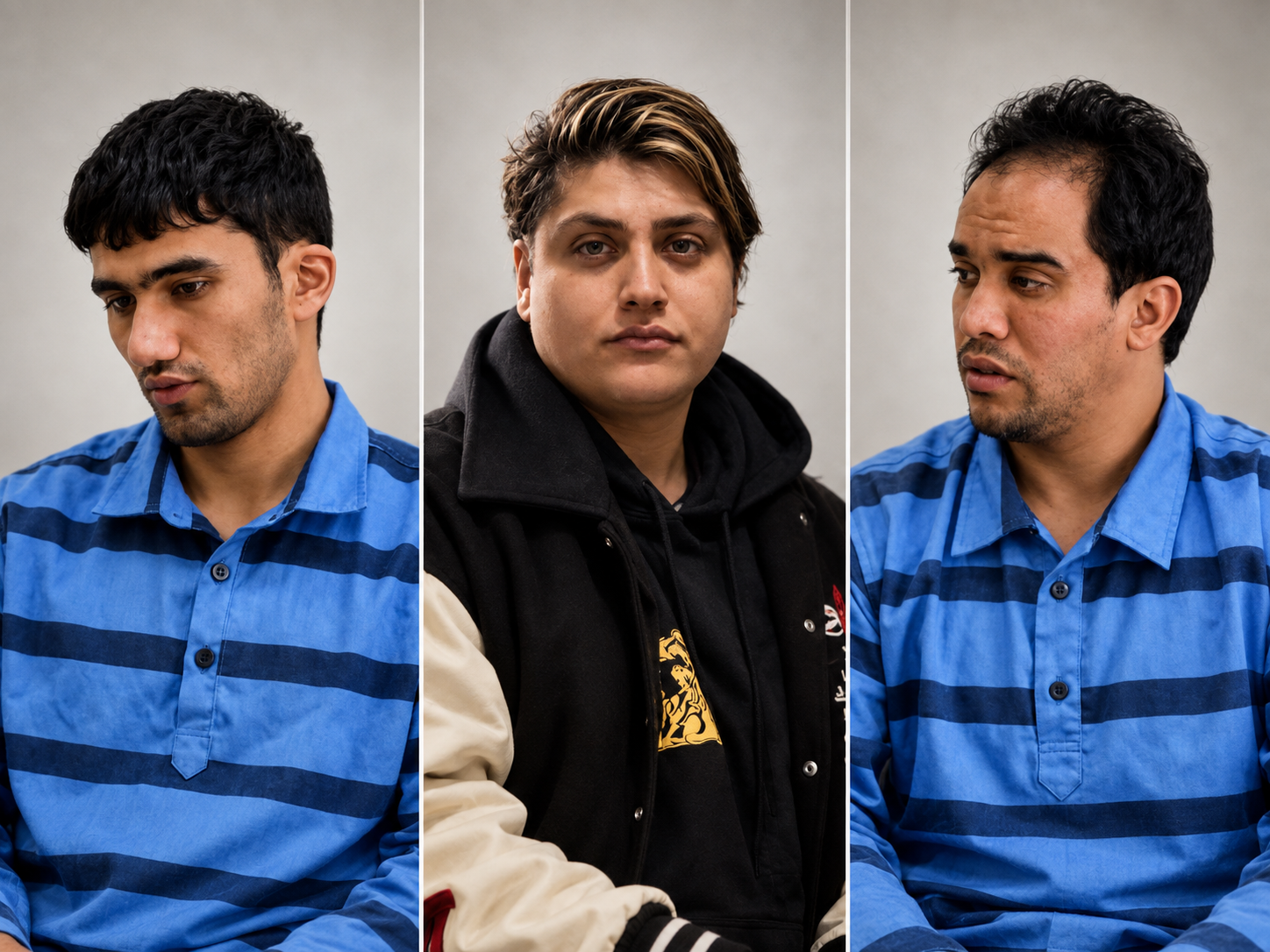
The executions mark the latest expansion of the use of capital punishment against people detained during the January 2026 uprising. At least 31 people have now been executed in cases related to the protests, while many others remain at risk. Among them is Mahboubeh Shabani, a 33-year-old political prisoner sentenced to death after reportedly using her motorcycle to transport wounded protesters to medical facilities. Her recent transfer to solitary confinement in Mashhad’s Vakilabad Prison has intensified fears that her sentence could soon be carried out.
Ali Hemmati and Majid Nik-Andish Executed in Mashhad
Iran’s judiciary announced that Ali Hemmati Sistanian and Majid Nik-Andish, two people arrested during the January 2026 uprising in Mashhad, were executed at dawn on Wednesday, September 30.
According to the judiciary’s media outlet, their death sentences had been upheld by the Supreme Court.
Hemmati and Nik-Andish were arrested in connection with protests in Mashhad. According to the official account, authorities accused them of participating in demonstrations on January 8 and 9 and of involvement in events in the city’s Tabarsi district that, according to the judiciary, resulted in the deaths of four members of the security forces.
The judiciary accused Hemmati of setting fire to a shop and blocking a road. Nik-Andish was also accused of participating in the January 8 and 9 protests, carrying a knife, damaging public property and taking part in an attack on a shop. Judicial media also claimed that during interrogation, the two men admitted to stabbing two members of the Basij paramilitary force.
These allegations, according to the judiciary’s account, formed the basis for their death sentences. Yet no independent information has been made public about the details of their trials, the extent of their access to lawyers, the evidence presented in court or the circumstances under which the statements attributed to them were obtained. In cases carrying the death penalty, such gaps make it impossible to independently assess whether basic standards of due process and a fair trial were observed.
The executions of Hemmati and Nik-Andish are part of an ongoing series of executions of people detained during the January uprising.
According to Iran Human Rights, Majid Adineh was executed on August 23, becoming the 29th January protester executed since March 19. Adineh had been arrested in Karaj and faced charges including “waging war against God,” assembly and collusion against internal security, propaganda against the state and possession of weapons and other equipment.
Earlier, Javad Zamani and Abolfazl Saedi, both detained during the January protests in Shahroud, were executed in June. The judiciary had accused them of offences including “waging war against God,” “corruption on earth,” using weapons, destruction of property and assembly and collusion against internal security.
With the executions of Hemmati and Nik-Andish, the number of people executed in cases related to the January uprising has reached at least 31, based on figures from Iran Human Rights and other human-rights reports.
The executions are only part of a larger group of capital cases stemming from the uprising.
Another political prisoner feared to be at imminent risk is Ali Zarei Dozdarrehsi, who had previously taken part in the Woman, Life, Freedom protests. Iran Human Rights reported that he was transferred to solitary confinement in Ghezel Hesar Prison on September 19, raising concerns that his execution could be imminent. Zarei has been sentenced to death for “corruption on earth” and, according to the organisation, said in an audio message from prison that his death sentence had been upheld.
While Hemmati and Nik-Andish have already been executed, the case of Mahboubeh Shabani shows how the threat of capital punishment continues to hang over those arrested during the same uprising.
Mahboubeh Shabani: Sentenced to Death After Helping Wounded Protesters
Mahboubeh Shabani, a 33-year-old political prisoner detained during the January 2026 uprising, said in an audio message from Vakilabad Prison in Mashhad that her lawyer had been formally notified of her death sentence.
In the same recording, Shabani said several other women detained in connection with the January protests and held in the prison’s women’s section were also at risk of execution. She described poor prison conditions and the psychological pressure created by the death sentences, and appealed to individuals and organisations able to support the prisoners to intervene.
Shabani was tried on September 1 by Branch One of the Mashhad Revolutionary Court. The charge cited in her ruling was “operational action aimed at strengthening Israel, the United States and actors affiliated with opposition groups.”
She has also faced the charge of “waging war against God” in connection with her assistance to wounded demonstrators. According to human-rights reports, during the January 8 and 9 protests in Mashhad, Shabani used her own motorcycle to take injured protesters to medical facilities.
She was arrested in Mashhad on February 2 in connection with the January uprising and transferred to Vakilabad Prison.
The Human Rights Activists News Agency (HRANA) reported that Shabani began a hunger strike on August 20 to protest her conditions of detention, the handling of her case and the denial of medical care.
On September 28, she was removed from a women’s section of Vakilabad Prison known as the “Calm” ward and transferred to solitary confinement. According to HRANA, prison authorities used violence during the transfer. No reason for the move has been announced.
At the same time, according to the Committee for the Freedom of Political Prisoners in Iran, telephone lines in Ward 6 and the “Calm” ward of Vakilabad’s women’s prison were completely cut, preventing prisoners from contacting their families or anyone outside the prison. Reports also indicated that the two wards were being cleared out.
The combination of Shabani’s transfer to solitary confinement, the communications blackout and the recent executions of other January protesters has heightened concern over her fate and that of other women held at Vakilabad.
According to the latest information from HRANA, Maryam Hedavand, Leila Abolhasani and Taraneh Rahimi also face death sentences in cases connected with the January uprising. The Supreme Court recently overturned the death sentence of another woman, Mahnaz Chardoli.
Iran Human Rights said on September 14 that at least 100 detained protesters connected with the January uprising faced death sentences. The figure was based on documented cases across 13 provinces and, according to the organisation, could be lower than the real number because of the judiciary’s lack of transparency.
The Scale of the Crackdown
The executions are unfolding against a much broader dispute over the scale of the killings during the January uprising.
In a report published on September 17, Iran Human Rights said that after months of gathering information, cross-checking sources and verifying identities, it had compiled a list of more than 4,200 people killed during the uprising.
Among those identified were at least 420 women and 281 children under the age of 18. Twenty-five of the children were younger than 14, and the youngest recorded victim was a four-and-a-half-month-old infant.
HRANA, meanwhile, reported that it had identified 7,007 people killed between December 28, 2025 and February 15, 2026, while more than 11,000 additional cases remained under investigation.
The Islamic Republic, by contrast, has put the official death toll at 3,117. In statements publicised on January 21, state authorities classified 2,427 of the dead — including civilians and members of the security forces — as “martyrs” and portrayed them as innocent victims of the violence. The authorities blamed much of the killing on armed “terrorist” groups that they said were backed by the United States and Israel. The remaining 690 dead were classified by an Interior Ministry security official as “terrorists, rioters and those who attacked military sites.” This framing forms part of the Islamic Republic’s broader narrative that the bloodshed was primarily the result of a foreign-backed terrorist operation rather than the state’s crackdown on protesters.
The widening use of capital punishment adds another layer to the repression that followed the uprising. Beyond the disagreement over how many people were killed in the streets, dozens of those who survived the crackdown have since been executed, while many others remain in prison under death sentences whose judicial basis and proceedings cannot be independently scrutinised.