

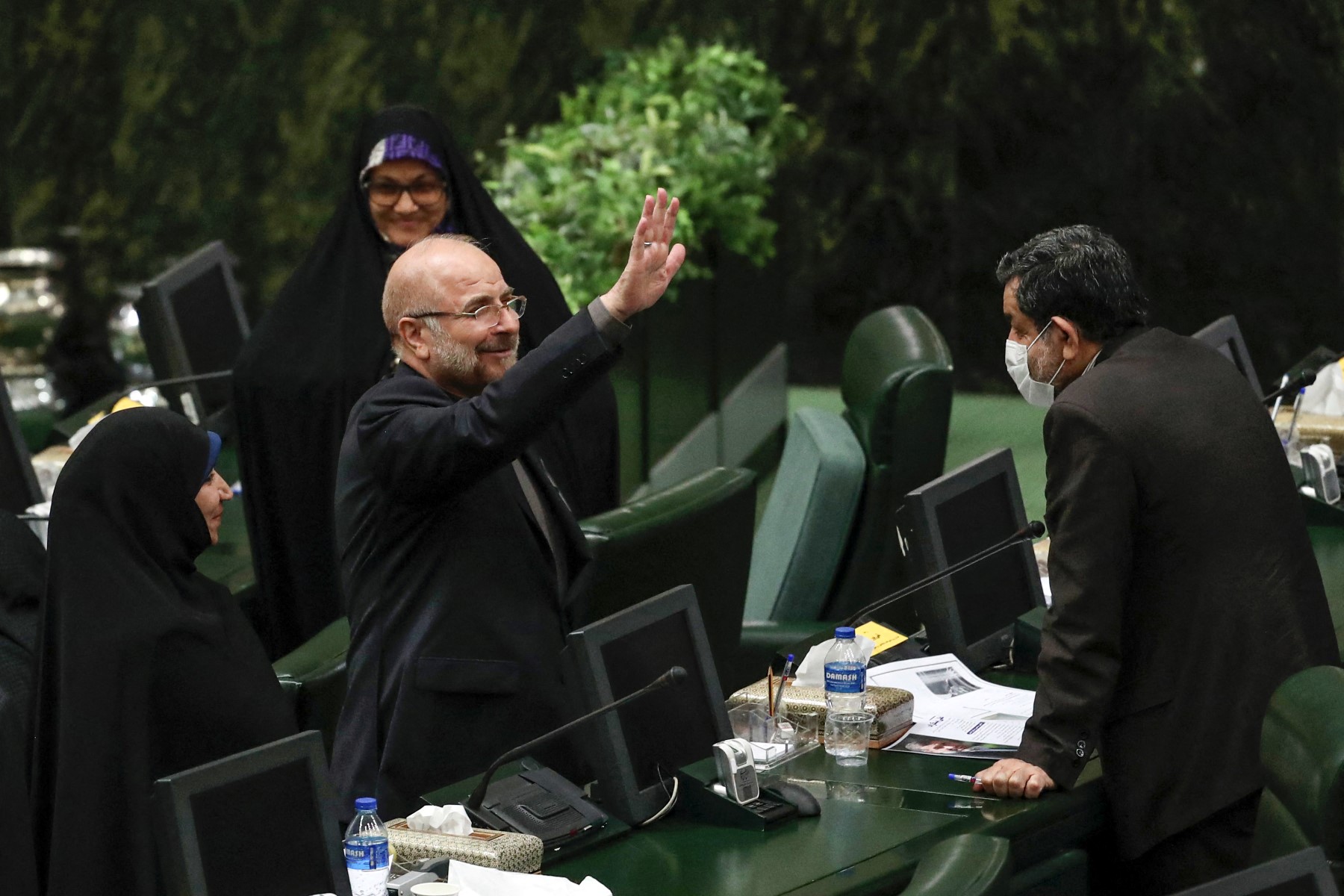
Iran’s parliament remains dominated by hardliners, while Speaker Mohammad Bagher Ghalibaf takes a more pragmatic line. Is this a real divide or a calculated division of labour?
For months, Iran’s parliament has not convened in person for security reasons, while lawmakers have been excluded from some of the country’s most important decisions, from negotiations with the United States to security agreements. At the same time, the divide between Mohammad Bagher Ghalibaf and parliament’s hardline faction has become increasingly visible. Zamaneh spoke with a member of parliament’s National Security Commission, a reformist political activist, and a political analyst to examine what lies behind this divide: a genuine conflict within the power structure, or a division of labour between Ghalibaf’s pragmatism and parliament’s radicalism?
The last plenary session of Iran’s parliament was held on 17 February 2026. Following the US-Israeli attack on Iran on 28 February, the Supreme National Security Council placed Tehran at a “red” security alert level and prohibited parliament from convening in its plenary chamber. Yet even after the ceasefire between Iran, the United States, and Israel, the ban remained in place. It continues to this day.
Abbas Goudarzi, spokesperson for parliament’s Presiding Board, told the House of the Nation [is it clear what is meant by this] news agency on 1 June that the continued suspension was based on security directives:
“The Presiding Board has no objection to holding sessions, but this requires the approval of the security authorities. With the beginning of the Third Imposed War, despite the Presiding Board’s desire to conduct parliamentary sessions in the usual manner, repeated correspondence from security agencies has meant that sessions are being held virtually.”
The continued suspension of in-person parliamentary sessions throughout 2026 has drawn criticism from some MPs, mainly those belonging to parliament’s more hardline faction. Hamid Rasaei, one of its prominent figures, criticised the situation on 10 August:
“The secretary of the Supreme National Security Council holds a legal position. The president appoints the SNSC secretary [what is SNSC? Maybe best to bring first the full expression and then mark it in paranthesis]. Can someone appointed by the president shut down parliament? The secretary of the Supreme National Security Council is not in a position to close parliament. Under the law, even if the Supreme National Security Council approves something, it is not binding unless the Leader has approved it. If the SNSC approved parliament’s closure and the Leader endorsed it, then all of us will accept it.”
Parliamentary hardliners do not regard the few virtual meetings that have been held as a genuine reopening of parliament. More importantly, they want the Supreme National Security Council’s decision suspending plenary sessions to be formally confirmed by the Islamic Republic’s new leader. The SNSC’s response has been that the decision was indeed approved by the Leader; otherwise, the council would not have issued it.
In practice, dissatisfied MPs are demanding something difficult to achieve under current security conditions: proof that Mojtaba Khamenei personally approved the decision. For MPs such as Hamid Rasaei, statements by President Masoud Pezeshkian, as president and head of the SNSC; Mohsen Rezaei, as SNSC secretary; and Mohammad Bagher Ghalibaf, as parliament speaker and an SNSC member, are not enough. Meeting their demand would require the Islamic Republic’s new leader to appear publicly and confirm the decision himself. Yet such an appearance would conflict with the security precautions surrounding the protection of the Islamic Republic’s third leader.
Two fundamental assumptions therefore appear to underlie the hardliners’ criticism. The first is that Mojtaba Khamenei is not alive and that senior officials within the Supreme National Security Council are making decisions in his name concerning a parliament dominated by hardline conservatives. The second is that Pezeshkian, Ghalibaf, and other senior officials have taken advantage of the new leader’s continued absence from public view to exclude the “revolutionary parliament” from major decisions during war and negotiations with the United States.
Against this backdrop, the news and analysis website Serat quoted the newspaper Nobonyad on 15 September:
“At a time when decisions concerning the future of the Strait of Hormuz and agreements related to the country’s security and national interests are on the diplomatic agenda, the role of the Islamic Consultative Assembly as the country’s supervisory and legislative institution remains shrouded in ambiguity… Why is parliament effectively excluded from the decision-making process on the country’s most important strategic issues? This disregard for parliament’s supervisory and legislative standing in decisions determining the country’s future was also evident when the Islamabad Memorandum was signed… At the time, a large group of 70 MPs independently drafted and signed eleven important and fundamental questions addressed to the head of the negotiating team and the then secretary of the Supreme National Security Council, two days before the Islamabad agreement was announced. According to Hamid Rasaei, none of those questions received an answer.”
On 1 September, Nobonyad also published an article by Hojjatoleslam Ghasem Ravanbakhsh, the MP for Qom, in which he wrote:
“Dr Ghalibaf! For God’s sake, come back to parliament so we can do something to confront the enemy’s cultural attacks. Mr Ghalibaf! Which is worse, a military attack on the country or a cultural attack? What happens if, during a military attack, the commanders who are supposed to resist the enemy instead help it and open the way for the occupation of the country?! The country is now under cultural attack, indeed under a cultural invasion, and our women, girls, and men are facing a cultural massacre. According to the available documents, these attacks originate from European embassies. They are planning to normalise homosexuality and nudity among Iran’s chaste women, and unfortunately some of the officials who are supposed to resist this invasion have themselves become the enemy’s accomplices!! It began with your own failure, and that of Mr Pezeshkian, to promulgate and implement the Chastity and Hijab Law, which has brought us to this disastrous situation today!”
Overall, the 12th Parliament currently appears to bear little resemblance to its speaker, whether on foreign or domestic policy. Ghalibaf’s positions are not to the liking of many conservative MPs, even though he himself is a conservative figure who was clearly supported by Ali Khamenei, the Islamic Republic’s slain former leader. The rhetoric of many MPs suggests much closer alignment with intensely hardline figures and organisations such as Saeed Jalili and the Paydari Front.
Why, then, is there so little political affinity between the 12th Parliament and its own speaker? Radio Zamaneh put this question to a conservative MP, a prominent reformist figure, and an independent political analyst.
Most MPs Agree with Ghalibaf but Fear the Hardliners and the Guardian Council
A conservative member of the 12th Parliament, who asked not to be named, told Zamaneh that the apparent gap between Ghalibaf and most MPs is exaggerated:
“Ghalibaf does of course belong to the conservative camp. But when someone is placed in the position of heading a negotiating team, naturally he tries to adopt positions appropriate to that role. The Quran says, ‘Is the reward for good anything but good?’ Ghalibaf has therefore tried to respond to the goodwill shown by the president and the government. Secondly, once Ghalibaf actually negotiates with the other side, he understands how difficult the task is and realises that achieving tangible results is not as easy as talking and chanting slogans. Still, I do not accept the idea that MPs are opposed to negotiations.”
The conservative MP believes that most representatives support negotiations. One reason, he says, is that parliament has effectively been shut down because of the security situation, preventing lawmakers from properly doing their jobs:
“There are, of course, a few MPs who have had internal political rivalries with Mr Ghalibaf. They are loud, and that causes people to think the whole parliament resembles them. But there are not actually that many MPs of this kind. Most representatives support negotiations.”
The MP also said that most representatives privately share Ghalibaf’s position on domestic issues such as compulsory hijab:
“They have the same position as Ghalibaf on hijab too. They are simply afraid to express it. The hardline group of MPs that has taken the lead thinks in apocalyptic terms and is angry that society is not observing hijab. They create an atmosphere in which other MPs prefer to remain silent rather than expose themselves to attacks from this hardline group. The hardliners do not understand that economic hardship has also contributed to the growing number of women refusing compulsory hijab. Nor do they want to accept that confronting women over hijab polarises society, which harms the system because it creates the impression that women without hijab are regime opponents seeking its overthrow. I know that when it comes to the Chastity and Hijab Law, most MPs are on Ghalibaf’s side.”
According to this conservative MP, most representatives are not actually afraid of parliament’s extremists; they are afraid of the Guardian Council. They fear that hardline MPs will report their positions to the council, resulting in their disqualification from standing in the next election. He argues that the reason most MPs voted for the Chastity and Hijab Bill was that the parliamentary majority remains aligned with the political system’s mainstream. In practice, however, this does not necessarily mean that most MPs support enforcing the law.
The Power Structure Will Not Allow Anyone Other Than Ghalibaf to Become Speaker
A reformist political activist, who also asked not to be named, offered a different explanation. In his view, the mismatch between Ghalibaf and many MPs reflects parliament’s lack of independence, the imposition of its speaker from above, and Ghalibaf’s participation in decision-making structures that operate at a higher level than parliament itself. He told Radio Zamaneh:
“Generally speaking, after the November 2019 events, Iran’s electoral system, at least as far as parliament is concerned, became fundamentally distorted. Its connection with the realities of society was severed. Parliament’s composition does not reflect social reality. It does not even reflect what the political establishment itself necessarily wants. That is why you end up with a parliament composed of MPs who have received only a few per cent of the popular vote, an extremely small proportion. And even if this group of MPs opposes the speaker, the power structure does not allow anyone else to take the position. It orders them to support a particular person, and because MPs lack independence, that individual becomes speaker.”
According to this reformist activist, the power structure would never allow second-tier hardliners to become parliamentary speaker. The current situation is therefore largely the product of a disconnect between power and accountability. MPs possess power but do not regard themselves as accountable for its consequences, whereas the wider political structure must, to some extent, consider questions of responsibility. This makes it possible for someone politically at odds with the composition of parliament to become its speaker. Even if the speaker is not initially at odds with parliament, the distance grows because major decisions are being made at an entirely different level.
The reformist, criticising the condition of Iran’s parliament since at least November 2019, added:
“Iran’s parliament has no independence. Not only does it lack independence, it also lacks coordination. Parliaments in other countries, while independent, are nevertheless part of the political structure. They do not simply make arbitrary decisions. They are accountable for their decisions. In democratic countries, therefore, the separation of powers coexists with coordination among those powers. But in Iran, in my view, things have moved far beyond any of that.”
The Hardline Parliament Plays the Role of the ‘Bad Cop’
Hamid Asefi, an analyst of Iranian politics, offered a third interpretation. He agrees that Iran currently has a “hardline parliament” alongside a comparatively moderate speaker, but sees the contrast not as a contradiction but as a deliberate division of labour:
“The apparent difference between Ghalibaf’s ‘public face’ and the parliament’s ‘radical body’ is not a contradiction but a ‘designed division of labour’. As a security technocrat, Ghalibaf needs negotiation and de-escalation for the survival of the political structure. But to win concessions in international negotiations, he also needs ‘leverage’ at home. In effect, the hardline parliament plays the role of the ‘bad cop’. When its members shout anti-American slogans or pass restrictive legislation, Ghalibaf gains greater room for manoeuvre as the regime’s ‘voice of reason’. He can show international counterparts that if they do not reach an agreement with him, they will instead have to deal with a hardline parliament. This radicalism is therefore not an obstacle to Ghalibaf’s work but a form of political capital that helps him extract concessions.”
Asefi also argues that the 12th Parliament’s rhetorical radicalism serves another important political function: containing the Islamic Republic’s own extremist social base. He explained:
“This parliament functions as a ‘safety valve’. By concentrating on ideological issues such as hijab and security, its members channel and defuse the anger of the system’s traditional and hardline constituency, allowing Ghalibaf to pursue strategic questions and the survival of the system at higher levels. Parliament effectively supplies propaganda to the regime’s social base in order to prevent that constituency from rebelling against the political establishment as a whole.”
Finally, Asefi argues that the difference between Ghalibaf and the “hardline parliament” is not one of political objectives:
“The final point is that Ghalibaf is not ‘free’. The difference between him and the hardline representatives is not a difference of ‘goals’ but of ‘methods’. The radical MPs are in parliament precisely to keep Ghalibaf on a leash. If he moves too far towards pragmatism and strays from the red lines, this same current can threaten his entire credibility and position with accusations such as ‘infiltration’ or ‘lack of commitment’. Ultimately, this is not a divide between ‘reason and ignorance’. It is a division of labour between executive management and the ruling ideology: a parasitic coexistence in which parliament’s radicalism provides cover for Ghalibaf’s strategic conservatism, while Ghalibaf’s position provides an umbrella of legitimacy for parliament’s extremism.”