

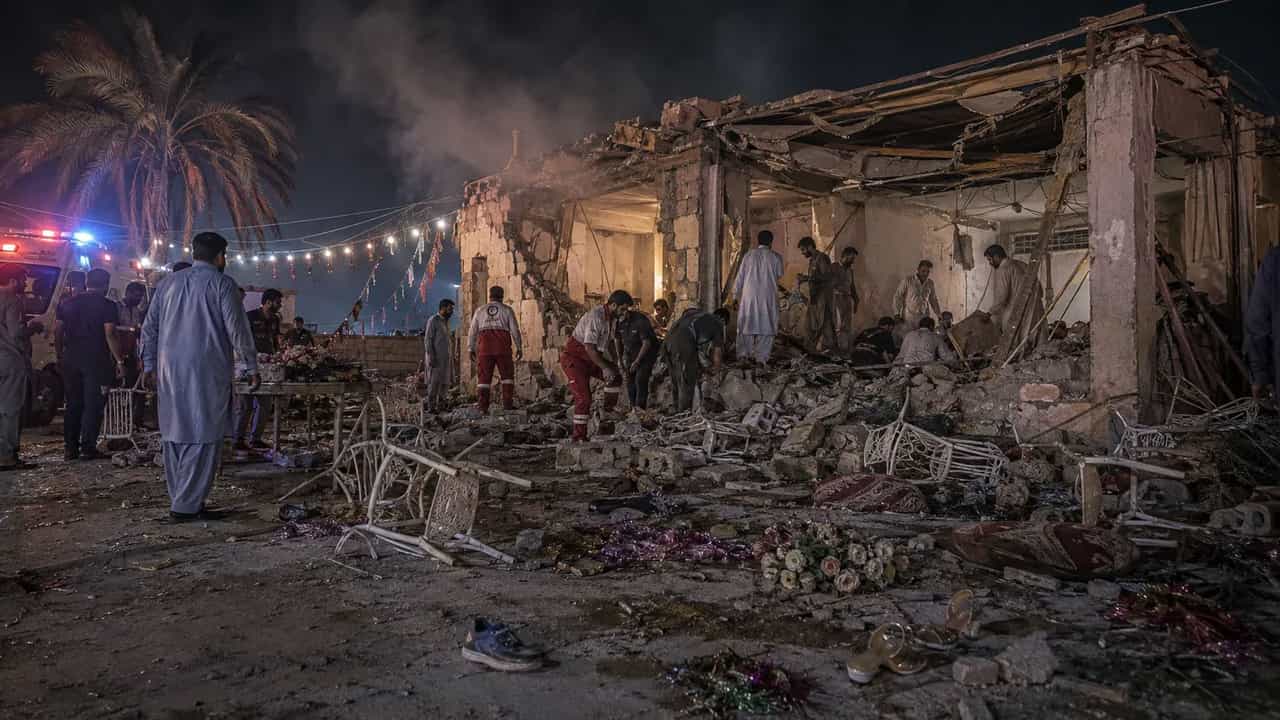
Satellite, visual and open-source evidence from Kuhestak challenges early claims that wedding casualties were merely collateral damage from a strike on a nearby telecommunications tower.
A U.S. attack in Kuhestak, in Iran’s southern Hormozgan Province, hit a house hosting a wedding, killing at least four people and injuring 67. Initial accounts described the casualties as “collateral damage” from a strike on a nearby telecommunications tower. But analysis of images, CCTV footage and satellite data shows that the house and the tower were around 130 to 140 metres apart, while the building hosting the wedding appears to have been struck several times, separately from the tower.
The attack on the evening of Tuesday, September 1, on a residential house in Kuhestak, in Sirik County, where a wedding was under way, has once again brought civilian casualties in the U.S.–Iran war into focus. The central question is whether the damage to the wedding venue resulted from an attack on the nearby telecommunications tower, or whether the building itself was directly hit.
The U.S. military has provided no detailed account of what it intended to hit in Kuhestak. As with similar strikes in Lamerd, Qeshm and Minab, it has offered only general statements. In the absence of such an account, photographs, CCTV footage and satellite imagery provide the clearest available evidence for reconstructing what happened. Evidence drawn from these sources raises serious questions about the initial claim that the casualties were simply collateral damage from a strike on the tower.
According to the latest figures released by Iranian authorities, at least four people were killed and 67 injured in the strike on the wedding. Iran’s Health Ministry said that U.S. attacks across the country on Tuesday night killed 18 people and injured 108. The Iranian Red Crescent confirmed four deaths at the wedding, while reports indicate that women and children were among those injured.
Reuters matched photographs from the scene with satellite imagery, confirming the location of the damaged building and its distance from the collapsed telecommunications tower.
The reported victims of the Kuhestak strike were four-year-old Amir-Ali Karimi, 16-year-old Mohammad Mollahi, Kolthoum Mollahi and Zarkhatoun Taheri. Images from hospitals in the area have also shown injured children and their families. Ali Mollahi, the owner of the house where the wedding was being held, told Iranian state television that everyone in the house was a civilian and that an ordinary wedding celebration had been under way.

How Far Was the Telecommunications Tower from the Wedding?
U.S. Central Command, CENTCOM, said that its wave of strikes that night had targeted air-defence and radar systems, naval assets and facilities, mine-laying capabilities and “IRGC communications centres.” No party has disputed that the attack in the area was carried out by the United States.
In the first hours after the strike, reports circulated claiming that the main U.S. target had been a telecommunications tower close to the wedding venue. Some Telegram channels described the house as being “next to an IRGC communications tower” or “across the street” from it. Another video claimed that an IRGC air-defence missile had struck the building following an unsuccessful interception. There was no substantial evidence for this claim, and it was quickly abandoned.
But the distance between the tower and the house was considerably greater than the “few metres” or “across the street” suggested in some of those early reports.
In its independent examination of the incident, Reuters matched images from the scene with satellite imagery and calculated the distance between the collapsed telecommunications tower and the damaged building at 136 metres, or 149 yards. Another open-source geolocation placed the distance at around 430 feet, approximately 131 metres. BBC Verify has also said that no visible military facilities could be identified within the area it examined.
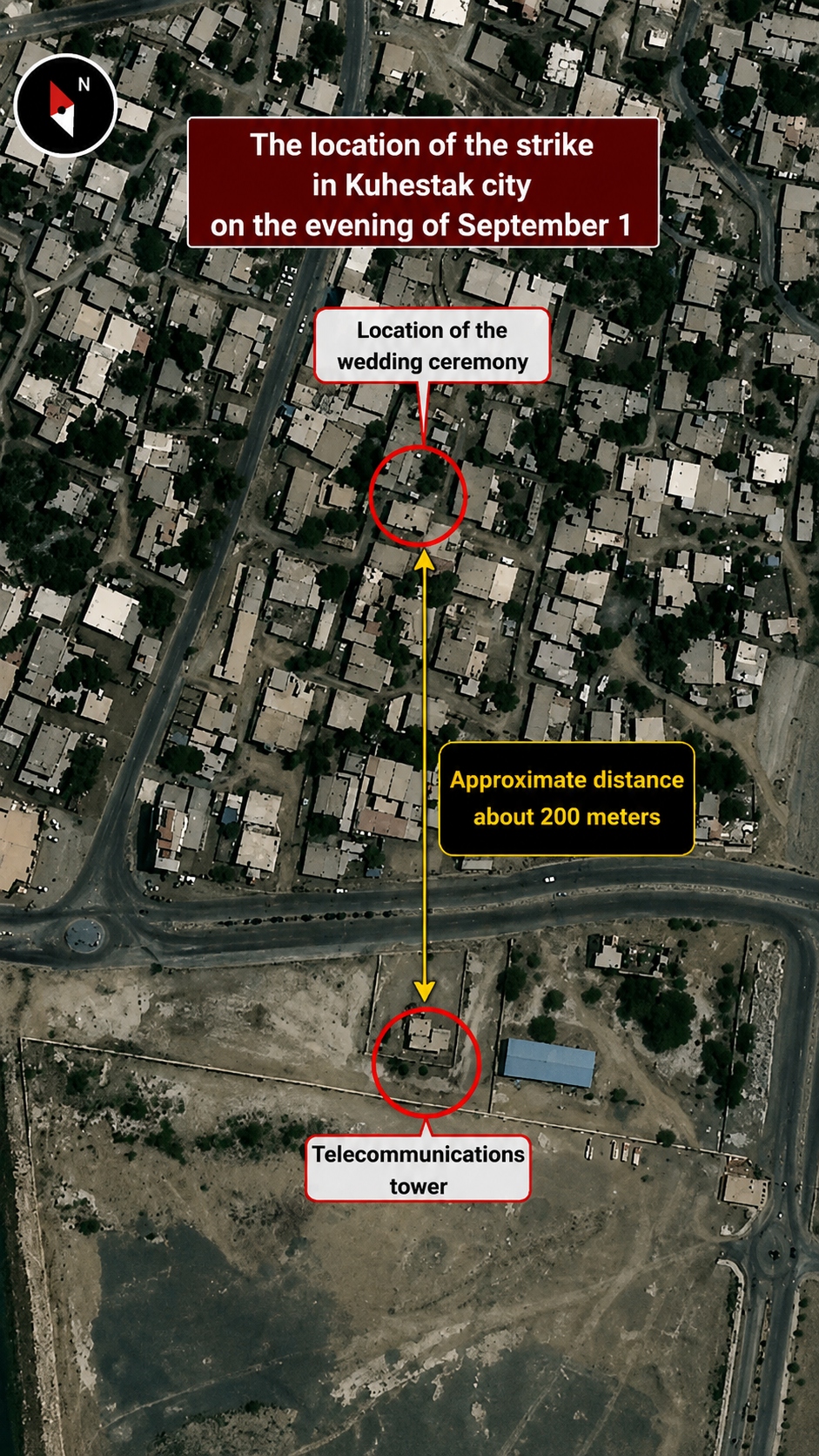
Despite differences in measurement methods, the available independent evidence therefore indicates that the telecommunications tower and the house that was struck were not a few metres apart, but approximately 130 to 140 metres from one another.
A different account was published by the news organisation Haalvsh, citing local sources. According to its follow-up report, the telecommunications tower stood around 200 metres from the house where the wedding was taking place and was struck first by a missile. Two drones then hit the wedding building, according to Haalvsh’s sources. Haalvsh stressed that without an independent inspection of the site and analysis of the munition debris, it could not definitively identify the type of weapon used or establish responsibility for the individual strikes.
What Does the Footage Show?
Available footage appears to show five separate impacts in Kuhestak: the first three apparently striking the house where the wedding was taking place, the fourth hitting the telecommunications tower, and a fifth apparently striking the wedding venue again. Several other residential houses were also damaged.
Al Jazeera, after examining the available footage, reported that a video filmed from a distance shows at least one direct strike on the roof of the building where the wedding was taking place. Other footage shows the telecommunications tower being struck and destroyed.
Weapons experts have said that fragments of munitions recovered at the scene in Kuhestak may be from a variant of the AGM-84K SLAM-ER air-launched cruise missile, although the type of weapon used has not yet been independently confirmed.
It remains unclear why the house appears to have been struck several times. The United States has remained silent and has not claimed that the house or wedding venue was located inside a military area. So far, no party has publicly described the wedding venue itself as a military site.
Why was the house struck? We do not know. What the available footage does challenge, however, is the early claim that the wedding casualties were simply “collateral damage” from an attack on the telecommunications tower. CCTV footage appears to show the residential building being struck several times, separately from the tower.
CENTCOM has so far provided no detailed operational explanation for what happened at this location. Captain Tim Hawkins, a CENTCOM spokesperson, responded to reports of civilian casualties by saying: “Unlike the IRGC, the U.S. military does not target civilians.” He added that the United States was aware of reports that initially appeared in Iranian state media.
His response did not clarify what the designated target in Kuhestak had been, why the residential building was hit, or whether the U.S. military intends to investigate the incident.
From Minab and Lamerd to Qeshm
Kuhestak is not the first case in this war to raise questions about target selection and civilian casualties.
The deadliest example came on the first day of the war, February 28, when a girls’ school in Minab was struck. Around 160 civilians, most of them schoolchildren, were killed. The Pentagon opened an investigation into the incident, but six months later it has still not released its findings. Two sources familiar with the investigation previously told Reuters that one possibility under examination was the U.S. military’s use of “outdated targeting information.”
If U.S. responsibility for the incident is formally confirmed by the Pentagon, Minab would rank among the deadliest incidents involving civilian casualties caused by a U.S. military operation in recent decades. This may also explain why publication of the Pentagon’s investigation has repeatedly been delayed.
The case of Lamerd resembles Minab, although on a smaller scale in terms of civilian deaths. Investigations by the Associated Press and Airwars examined the February 28 strikes on a sports complex and two residential neighbourhoods in Lamerd. According to their findings, three missiles, most likely Precision Strike Missiles, or PrSMs, exploded in the area, killing at least 21 civilians, including seven children. Some of the victims were as far as 50 metres from the points of explosion, while damage was documented up to roughly 170 metres away.
The significance of those findings lies partly in the type of munition involved. The PrSM detonates in the air, dispersing tens of thousands of dense metal fragments at high velocity in multiple directions. By analysing photographs, videos and satellite imagery, Airwars and the Associated Press concluded that the pattern of holes left in buildings, vehicles and streets was consistent with the characteristics of this weapon.
The U.S. military has confirmed using PrSMs in the Iran war but has denied responsibility for the Lamerd strike. At the same time, the independent investigation by the two organisations found no evidence that military or security personnel had been killed, or that military facilities had been struck, at any of the three locations they examined.
There have also been reports of civilian targets being hit in Qeshm. In a U.S. attack on Qeshm on July 30, a residential house was struck, killing a couple and their two-year-old child and injuring two other children in the family.
The Associated Press had also previously reported that a U.S. strike on a desalination facility in Qeshm disrupted the water supply to around 30 villages. In other words, not only civilians but also infrastructure essential to their daily lives has been hit.
The UN Response and the Laws of War
UN Secretary-General António Guterres expressed grave concern over rising civilian casualties following reports of the strike on the wedding in Kuhestak and called for an immediate halt to military operations.
His spokesperson, Stéphane Dujarric, said the secretary-general condemns “all attacks against civilians” and stressed that all parties to the conflict are required to comply with their obligations under international humanitarian law, including the principles of distinction, proportionality and precaution.
Under international humanitarian law, civilians and civilian objects must not be targeted. An attacking party must distinguish between military and civilian targets, take feasible precautions before an attack to minimise harm to civilians, and refrain from an attack when the expected incidental civilian harm would be excessive in relation to the concrete and direct military advantage anticipated.
The mere presence of a telecommunications tower around 130 to 140 metres from a civilian residence would not, by itself, establish that civilian casualties at the house were lawful collateral damage.
It must first be established whether the tower itself, given the way it was being used at the time, constituted a legitimate military objective. Investigators would then need to examine the type of munition used, its precision, what information operational planners had—or could reasonably have obtained—about the presence of dozens of civilians around the target, and what precautions they took.
Footage appearing to show direct strikes on the wedding venue, however, takes any investigation beyond the question of collateral damage alone.
If it is officially confirmed that several projectiles struck the wedding building directly and separately, an investigation could no longer focus only on the blast radius or fragmentation produced by a strike on the telecommunications tower. It would then have to establish why the building itself was selected for targeting and on what intelligence the U.S. military considered it a lawful military objective.