

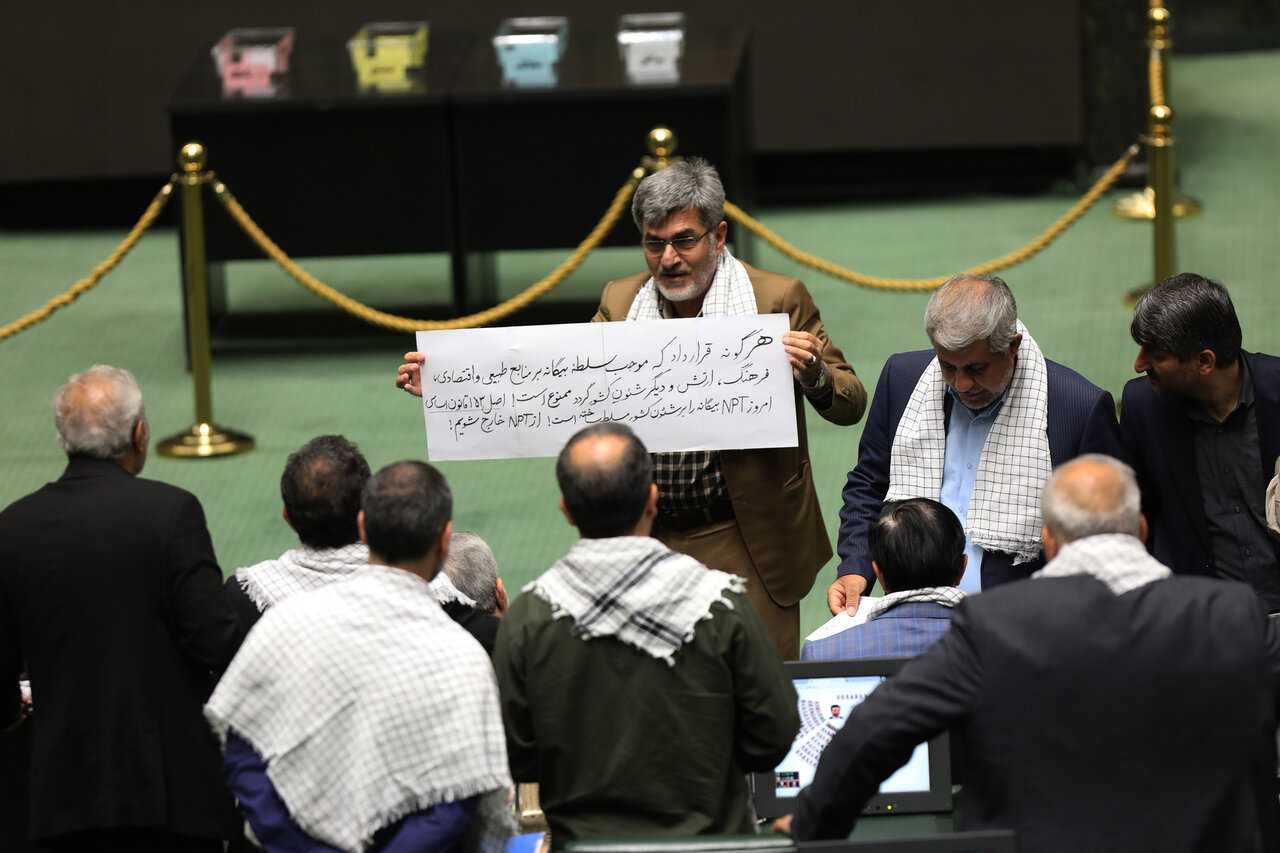
Iran’s parliament has approved the general framework of a controversial bill that expands the definition of “foreign influence,” potentially criminalising ordinary forms of contact with foreign media, academic institutions, and international organisations.
Iran’s parliament has approved the general framework of a bill titled “Countering the Infiltration of Foreign Intelligence Services and Institutions.” The proposal has triggered widespread concern among political, legal, and media circles over its potential consequences for civil society, academic exchange, and freedom of expression.
The bill has not yet become law. However, according to sociologist Saeed Madani, even before its final approval, several people arrested during the January 2026 protests were sentenced to death based on similar legal provisions.
Supporters of the bill, including the lawmakers who drafted it as well as security and judicial institutions, argue that it aims to “close security gaps” and “fill legal loopholes.” Critics, however, warn that its broad definitions could turn ordinary forms of communication and cooperation into criminal offences.
The bill introduces strict restrictions on foreign communication, media activities, and academic cooperation. According to the published text:
Foreign media contacts: Any interview, conversation, or sharing of information with foreign media outlets—particularly those affiliated with hostile states or receiving foreign funding—without official authorisation could lead to six months to two years in prison.
International and diplomatic contacts: Providing documents or reports to, or communicating with, embassies, consulates, and international organisations inside or outside Iran would require written approval from the Foreign Ministry and security institutions.
Academic and research cooperation: Receiving foreign scholarships, participating in joint research projects with overseas institutions, or attending international workshops without approval from intelligence authorities would become punishable offences.
The bill also restricts participation in or organisation of in-person or online educational courses that, according to security authorities, are “under the supervision, direction, or training of foreign intelligence services” or are deemed “incompatible with Iranian culture” or opposed to official cultural policies.
One article specifically addresses foreign nationals, making entry and residence conditional on legal procedures and imposing fines of up to €10,000 as well as deportation for violations. It also introduces harsher penalties for foreign nationals convicted of other offences inside Iran.
Another section establishes penalties, including imprisonment and fines, for those accused of facilitating “economic influence.”
Under the proposed law, the Ministry of Intelligence and the IRGC Intelligence Organisation would serve as the main enforcement bodies responsible for gathering evidence and submitting cases to the judiciary.
Turning Everyone into a Suspect
Supporters of the bill argue that existing provisions in Iran’s Islamic Penal Code only addressed traditional forms of “espionage” and were insufficient to confront newer forms of foreign influence operating through academic, civil, and media channels.
Abbas Goodarzi, spokesperson for parliament’s presiding board, described the bill as a measure to protect “independence, sovereignty, national security, and Iranian-Islamic cultural identity.”
The spokesperson of parliament’s National Security Commission claimed that the legislation would prevent foreign intelligence services from exploiting non-governmental organisations and other social institutions as covers.
Other lawmakers similarly presented the bill as a necessary response to threats from “enemies,” arguing that it was not intended to restrict freedom of expression or target ordinary citizens.
Alireza Salimi, a member of parliament’s presiding board, described it as a “legal tool to safeguard national sovereignty and the country’s highest interests against foreign interference.” He rejected reports that the bill would punish people connected to Iranians abroad, claiming that it was “only about foreign infiltration.”
Critics, however, argue that the problem lies precisely in how broadly the bill defines infiltration and security threats.
Warnings Over the Expansion of Security Control
Legal experts and social researchers have warned that vague definitions could allow security institutions to criminalise a wide range of activities. The newspaper Etemad described the bill as potentially dangerous in several respects, calling its first article the “mother of all accusations” because of the broad scope it gives to allegations of foreign influence.
One of the main concerns is the unprecedented expansion of the powers of the Ministry of Intelligence and the IRGC Intelligence Organisation, the two institutions designated as the bill’s main enforcement authorities.
Etemad identified ten major problems with the legislation, arguing that the central issue is not only the breadth of its restrictions but the understanding of security and governance behind it:
“The most important problem with this approach is that instead of addressing the real roots of security vulnerabilities, it shifts attention toward control, restriction, and expanding the scope of criminal offences.”
Hesamoddin Ashena, a former adviser to President Hassan Rouhani and a former security official, described the bill as unconstitutional and vague.
Hamidreza Goodarzi, a member of parliament, also criticised the legislation as creating “greater pressure on society” and warned that it had been rushed through.
A State of Emergency as a Tool for Executions
The sharpest criticism, however, came from sociologist Saeed Madani, who was released from prison several months ago. In an interview published by Panorama, Madani warned that the bill would contribute to the securitisation of public life, further isolate Iran’s scientific and educational institutions, weaken civil society, and accelerate the erosion of social trust.
He argued that many of the death sentences issued after the January 2026 protests were based on the “Law on Increasing Punishments for Espionage and Cooperation with Israel and Hostile Governments Against National Security and Interests.” Madani described this law, along with similar legislation, as “a step backwards.”
The “Law on Increasing Punishments for Espionage” was approved and enacted in November 2025. One of its provisions required the Ministry of Intelligence to publish the names of individuals, media outlets, and online pages deemed hostile. Seven months after the law came into force, the ministry released such a list. Madani said that in the period between the law’s approval and the publication of the list, individuals had already been sentenced to death under these provisions.
He also criticised provisions granting judges greater powers during investigations, arguing that they have contributed to shorter trials, expanded authority for security institutions, increased pressure on defendants to confess, restrictions on access to independent lawyers, and even punishment of defendants’ families.
Referring to the case of Pouya Ghabadi, who was executed on charges of links to the People’s Mojahedin Organization of Iran (PMOI/MEK), Madani said:
“The case had once been overturned by the Supreme Court and sent back for retrial. The court issued the death sentence again, and while the case was still under review by the Supreme Court, before its final decision was announced, the sentences of six people were carried out.”
Madani said that using wartime conditions as an opportunity to issue and execute death sentences “undermines the entire legitimacy of the judicial system.”
He also referred to the case of four defendants accused of setting fire to a Basij base in Tehran, who were executed without a full judicial process. Mohammad Amin Bigleri, Shahin Hatami, and Amirhossein Hatami were executed in April 2026. Madani said they had been denied family visits after their arrest, were only allowed telephone contact from secure rooms, and did not even have access to appointed lawyers.
He argued that executions are increasingly being used as a tool of collective intimidation rather than punishment for specific crimes:
“The government appears to use executions as an instrument of collective intimidation, not merely as punishment for a defined offence. By constantly invoking wartime or emergency conditions, it is even setting aside existing laws.”
Madani warned that continuing on this path could lead either to “collapse” or “revolution,” though he said it remained unclear whether the political system would accept a transition.
A Dark Future
The parliamentary bill still requires two further stages before becoming law: approval of its detailed provisions by parliament and confirmation by the Guardian Council.
Given the current atmosphere in Iran—particularly after what the foreign minister described as a continuing “security breach” affecting decision-making, and amid accusations of “espionage” and “infiltration” directed at different actors within the ruling establishment—the rapid approval of this bill could further expand the use of imprisonment and execution as tools of political control.
At the same time, the bill’s future may also depend on broader political developments. A possible agreement with the United States, accompanied by sanctions relief and renewed foreign investment, could create tensions with legislation that restricts international economic and academic engagement.
Another factor is domestic. As the government and parliament debate changes to fuel prices, any decision over gasoline prices or quotas could trigger widespread social unrest. The presence of figures such as Hossein Taeb, Ahmad Vahidi, and Mostafa Izadi—longtime security officials involved in previous periods of repression—has raised concerns among critics that the state may be preparing for another wave of unrest.
The bill could also become a tool in internal power struggles within the ruling establishment. By creating broad accusations of foreign influence, it provides a mechanism for discrediting, removing, or even imprisoning political rivals.
It may require considerable optimism to imagine that the authorities will choose a different path and attempt to reduce the suffering of society. Such a shift would require not only suspending this bill but reversing the broader expansion of repressive laws and institutions. For now, however, that possibility appears distant.