

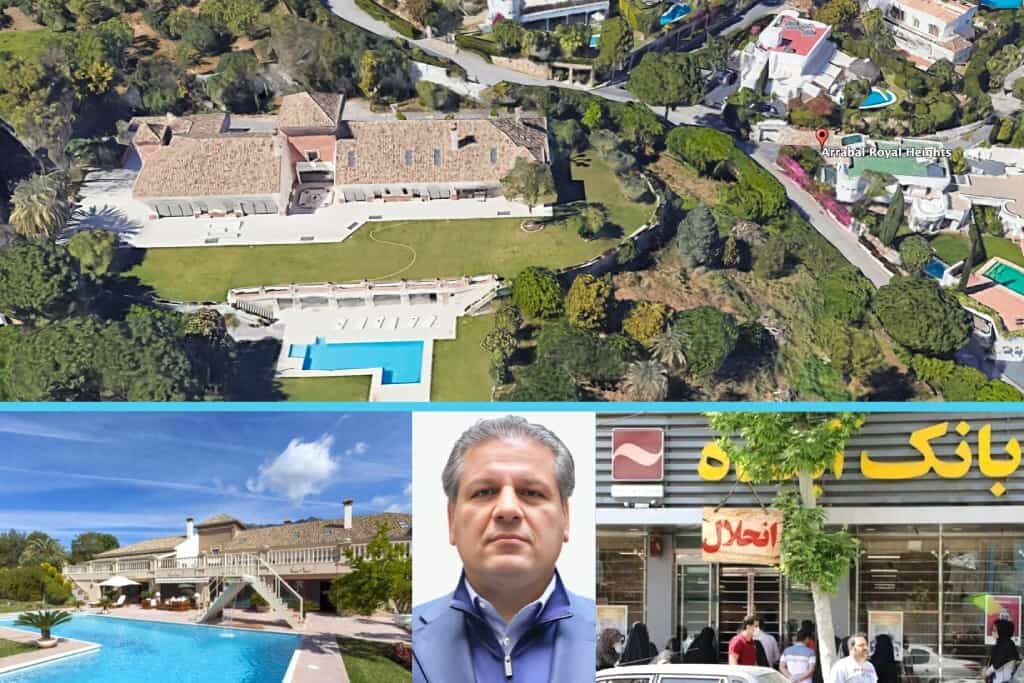
Nine months after Ayandeh Bank’s collapse, thousands remain caught in its fallout as documents trace Ali Ansari’s banking model, offshore transfers, and European property empire.
Nine months have passed since Ayandeh Bank was dissolved, yet thousands of its customers are still grappling with the consequences. On 23 October 2025, the private bank’s operating licence was revoked, its operations were halted, and its deposits and obligations were transferred to Bank Melli Iran. The reason was clear: Ayandeh Bank’s liquidity and capital indicators had deteriorated beyond recovery. Yet what appeared on paper to be an administrative transfer has, in practice, created serious obstacles for many customers seeking access to banking services.
Today, many former Ayandeh Bank customers are facing problems arising from the transfer of their accounts and files to Bank Melli. A recent report by the daily Ettelaat shows that some have been unable to obtain banking services, particularly new loans and credit facilities. The problem stems from the incomplete transfer and reconciliation of account information, payment identifiers, and loan files between Ayandeh Bank and Bank Melli. As a result, some unpaid instalments have been registered as overdue.
According to Ettelaat, this has led some customers to be wrongly listed as bank debtors with overdue loans. These customers have neither refused to repay their debts nor disputed what they owe. Rather, the absence of a functioning mechanism has made it impossible for them to make their instalment payments. Consequently, they have been denied loans they may need to start a business, cover medical expenses, purchase a home, or marry.
The report estimates that several thousand customers are facing this or similar problems with their loan files. Behind each case is an individual or family who may depend on bank credit to start a business, buy work equipment, pay for medical treatment, purchase a home, marry, or meet other essential needs.
The roots of the Ayandeh Bank crisis, whose consequences continue to affect former customers, cannot be reduced to mismanagement alone. An examination of the bank’s operations suggests that alongside mismanagement, there were signs of a deceptive financial mechanism at work.

The Roots of Ayandeh Bank’s Crisis: A Ponzi Scheme
An examination of financial statements and statements by Central Bank officials shows that the roots of Ayandeh Bank’s crisis lay in how it allocated resources and financed its liquidity needs. Ayandeh Bank was created in 2012–13 through the merger of three private banks and financial institutions. Rather than using much of the money it attracted from depositors for conventional lending, the bank channelled it to affiliated companies and projects connected to its principal shareholder, Ali Ansari. According to financial indicators published around the time of the bank’s dissolution, more than 90 percent of the funds it had attracted were channelled to a single affiliated group controlling projects including Iran Mall, Mashhad Mall, Farmanieh Mall, and the Rotana Hotel.
On the surface, everything appeared to be going well. The bank paid its customers higher returns than other private banks. The problem became apparent when the money it had channelled outward failed to return. Loans went unpaid, and a substantial share of the bank’s claims became non-performing or doubtful debts. According to official sources, loans extended to the Iran Mall project alone amounted to around 60 trillion tomans—roughly $550 million at the open-market exchange rate around the time of the bank’s dissolution—tying up a significant share of the bank’s capital and dramatically worsening its balance-sheet imbalance.
Central Bank officials say that continuing to pay interest to depositors under these conditions pushed Ayandeh Bank to attract new deposits by offering rates above those elsewhere in the banking system—a mechanism the Central Bank itself has described as a “Ponzi scheme.”
Hamidreza Ghaniabadi, the Central Bank’s director general of banking supervision, described the process in an interview:
One of the Central Bank’s most important priorities in reforming the banking system was resolving the situation at Ayandeh Bank, because the bank was suffering from a chronic and critical imbalance. Extensive efforts were made to restore its liquidity and capital indicators to normal levels, but this did not happen. From the beginning of its operations, Ayandeh Bank allocated the resources it attracted from depositors primarily to one particular group, affiliated companies, and projects connected to its main shareholder. As a result, those resources were not returned to the bank. At the same time, the bank continued paying monthly interest on deposits. Once the return of funds stopped, the bank had to attract new deposits and use them to pay interest to earlier depositors—a mechanism known in financial terminology as a “Ponzi scheme.” To attract these deposits, it offered interest rates above those approved by the Central Bank. As a result, Ayandeh Bank created unhealthy competition across the banking system, forcing other banks to raise their own interest rates in order to retain depositors.
This continued into late 2019 and early 2020. As the Central Bank tightened its supervision and prevented the payment of unusually high interest rates, Ayandeh could no longer attract new deposits by offering above-market returns, effectively bringing the mechanism to a halt. The bank then began relying on overdrafts from the Central Bank to make up for its liquidity shortages.
The consequences are clearly visible in Ayandeh Bank’s financial statements. By 20 December 2024, its accumulated losses had reached approximately 426 trillion tomans—roughly $5.6 billion at the open-market exchange rate at the time—more than three times the accumulated profits of Bank Mellat, the country’s most profitable bank.
By the time the bank was dissolved on 23 October 2025, accumulated losses had risen to approximately 550 trillion tomans, or around $5 billion at the exchange rate around the time of the collapse. Its debt to the Central Bank—including the principal of its overdrafts and associated penalties—stood at around 500 trillion tomans, approximately $4.6 billion. Its registered capital, meanwhile, was just 1.6 trillion tomans, equivalent to roughly $15 million.

Destination Cyprus: Ayandeh Bank’s Formation, Capital Transfers, and the Purchase of Citizenship
Alongside his banking activities, Ali Ansari also began moving capital out of Iran and acquiring foreign passports.
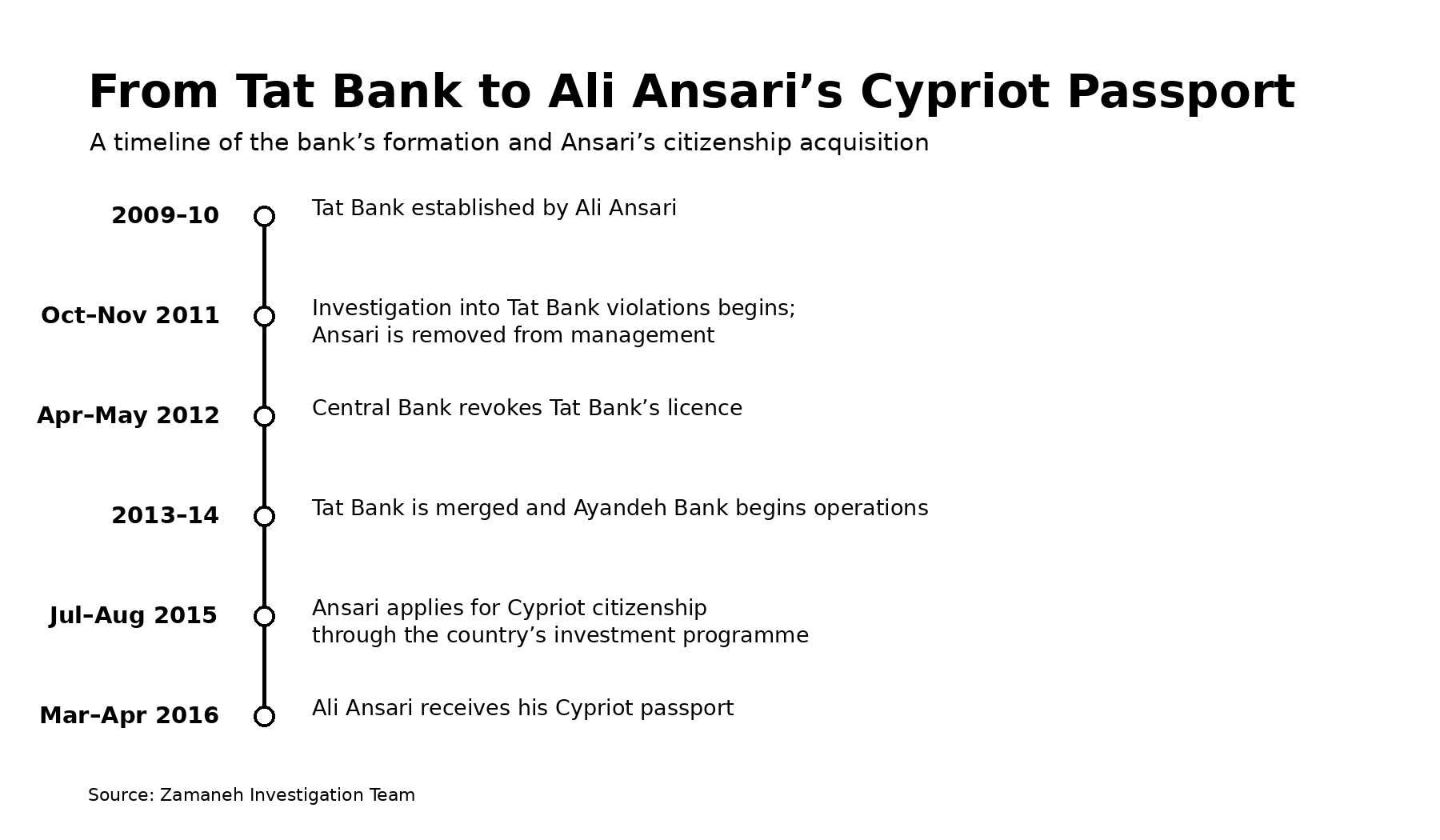
The origins of Ayandeh Bank go back to Tat Bank, established in 2009–10 with the participation of the Tat Group and with Ali Ansari playing a central role. In 2011, reports emerged of regulatory violations and irregularities at Tat Bank, prompting investigations by the Money and Credit Council and other supervisory bodies. Following these reviews, rather than allowing Tat Bank to continue operating independently, authorities decided to merge it with the Salehin and Pishgaman Kavir Yazd financial and credit institutions. The process resulted in the formation of Ayandeh Bank in 2012–13.
As Ayandeh Bank was taking shape and attracting funds from depositors, Ansari’s activities outside Iran also entered a new phase. Documents reviewed by Zamaneh for this investigation indicate that he was pursuing a plan to transfer assets to Europe while obtaining second and third citizenships. According to the documents, Ansari applied for Cypriot citizenship through the country’s investment programme on 31 July 2015 and received his Cypriot passport on 13 April 2016.
Ansari had already acquired citizenship and a passport from Saint Kitts and Nevis.
Documents indicate that between July 2015 and September 2018, Ali Ansari was involved in a series of direct and indirect financial transactions in Cyprus and Germany with a gross value exceeding €27.5 million.
Financial records show that capital was transferred through a network of companies registered in Cyprus and offshore jurisdictions, including Nevis. According to the documents, €5 million was placed in a fixed-term deposit at a Cypriot bank through Assilia Limited. A contract was also signed to purchase a property in Larnaca for €535,000, although a title deed was never issued. In addition, €5.5 million was transferred from Ansari’s personal account in Germany to Assilia’s account in Cyprus as collateral for a credit facility.
The documents reveal other financial transactions between affiliated companies, including the transfer of approximately €4 million between Aragmo Ltd in Cyprus and Ziba Leisure in Germany. Taken together, these transactions attracted the attention of European regulatory authorities.
The Cyprus-linked transactions represented only part of Ansari’s financial activities abroad. Property records show that he spent enormous sums acquiring real estate in Dubai, Germany, Britain, Spain, and France.
Ansari’s European Empire—and the Reach of Sanctions
While Iran’s banking system was buckling under the weight of Ayandeh Bank’s debts, the wealth Ansari had moved out of the country was being transformed into a sprawling property empire across Europe.
According to investigations published by the Financial Times and the Organized Crime and Corruption Reporting Project (OCCRP), around the time Ayandeh Bank collapsed and was dissolved in Iran, the value of Ansari’s assets in Britain and continental Europe had reached more than €400 million.
Hidden behind offshore companies, these assets included a £150 million London property portfolio. On the exclusive Bishops Avenue alone, he had acquired 12 vacant mansions worth £73 million, as well as another luxury mansion—with an indoor swimming pool and home cinema—for £33.7 million. Luxury apartments worth £36 million near Kensington Palace and an £8.1 million apartment in Buxmead made up another part of his London holdings.
His portfolio in the European Union was similarly extensive. It included the Steigenberger golf resort and spa in Mallorca, Spain, valued at €22 million; two Hilton hotels in Frankfurt, Germany, together worth approximately €160 million; the Bero Oberhausen shopping centre, valued at €68 million; and an ultra-luxury villa in Marbella, Spain, acquired through UK-registered companies and their Spanish subsidiaries.
But this European expansion eventually drew the attention of sanctions authorities. The United Kingdom sanctioned Ansari in October 2025, imposing an asset freeze, travel ban, and director disqualification. The United States followed in July 2026. The British government said Ansari had financially supported activities of the Islamic Revolutionary Guard Corps and facilitated hostile activity by the Iranian state. These measures placed significant parts of his international financial and property network within the reach of sanctions and sharply constrained his ability to control and benefit from assets in the relevant jurisdictions.

Promises After the Collapse—and Questions Over Regulatory Delay
After the process of winding down Ayandeh Bank began, Gholamhossein Mohseni-Eje’i, head of Iran’s judiciary, told a meeting of the Supreme Judicial Council on 27 October 2025 that Ayandeh Bank’s debts would not be transferred to Bank Melli and that shareholders and managers found to have played a role in potential wrongdoing would face legal action. He also called for an investigation into large deposits and how they had been accumulated.
These remarks came only after years of financial problems at Ayandeh Bank, including persistent balance-sheet imbalances, accumulated losses, extensive investment in real estate, and growing dependence on Central Bank resources.
The Ayandeh Bank case now raises a fundamental question: why were corrective and supervisory measures not taken before the bank reached the point of collapse?
Determining the responsibility of managers, shareholders, and regulatory institutions—and investigating potential violations and the status of related assets—will require formal proceedings and judicial documentation.